
8 Best Golf Swing Speed Monitors of 2026
This post contains affiliate links. As an Amazon Associate, we earn from qualifying purchases.
Many golfers struggle to gain consistent distance off the tee because they lack accurate, real-time feedback on their club head and ball speed. The best golf swing speed monitors solve this by delivering precise metrics like swing speed, smash factor, and launch angle—some even offering app-connected analytics and training modes to target speed development directly. We evaluated each model based on rigorous testing against a TrackMan launch monitor, prioritizing accuracy, usability, feature set, and value across various budgets. Below are our top picks for the best golf swing speed monitors to help you train smarter and maximize your power potential.
Top 8 Golf Swing Speed Monitors in the Market
Best Golf Swing Speed Monitors Review
RYP Golf Radar Swing Speed Monitor

ADVANTAGES
LIMITATIONS
This no-contact powerhouse delivers exceptional value for golfers who want instant, reliable swing speed feedback without breaking the bank. The RYP Golf Radar stands out with its ability to measure club head speed accurately—without needing to hit a ball—making it perfect for indoor practice or quick backyard sessions. Its real-time voice feedback and compact design solve the common frustration of guessing whether your latest drill actually improved your speed, giving you immediate, actionable data every time you swing.
In real-world testing, the RYP Radar consistently captured swing speeds from drivers to irons with impressive reliability, especially when used with training aids like the Rypstick. It measures in both MPH and KPH, stores the last 10 swings, and runs on standard AA batteries, making it highly portable and easy to use anywhere. However, it’s limited to swing speed only—no ball speed, smash factor, or launch metrics—so it won’t satisfy players looking for deeper analytics. It also performs best in open spaces, as nearby metal objects or electronic interference can occasionally skew readings.
Compared to more advanced models like the Swing Caddie SC200+, the RYP Radar is far more basic but excels as a focused, budget-friendly speed trainer. It’s ideal for beginners or casual players prioritizing swing speed gains over comprehensive data. While it lacks app connectivity or tempo tracking, it outperforms similarly priced competitors in simplicity and responsiveness—offering more speed insight for less money than most entry-level radars.
Swing Speed Radar with Bluetooth App

ADVANTAGES
LIMITATIONS
If you’re serious about building swing consistency and want your training to feel like a modern fitness regimen, this Bluetooth-enabled Doppler radar is a game-changer. It delivers pinpoint swing speed accuracy from 20 to 200+ MPH, works seamlessly with your smartphone, and offers voice-guided feedback through earbuds, turning every swing into a data-driven workout. The real-time app integration eliminates guesswork, letting you set goals, track progress by club, and focus purely on your motion—without staring at a screen.
During testing, the unit paired instantly with both iOS and Android devices, and the app provided clean, intuitive dashboards showing speed trends over time. It handled use with SuperSpeed sticks, Rypsticks, and real irons with ease, though it required slight elevation (up to 8 inches) when used with low-swing trainers to maintain line of sight. While it’s highly accurate in interference-free zones, performance dipped near Wi-Fi routers or fluorescent lights due to Doppler radar sensitivity, demanding a controlled environment for best results. It doesn’t measure ball flight or smash factor, keeping it focused purely on speed development.
Against the RYP Golf Radar, this model trades simplicity for smarter connectivity and deeper analytics, making it better suited for tech-savvy players and coaches. It’s not the cheapest, but it offers the best app experience in its class for swing speed tracking. For golfers committed to data-backed speed training, this radar delivers a more immersive, guided experience than basic standalone units.
Swing Speed Radar with Tempo Timer

ADVANTAGES
LIMITATIONS
This 25-year veteran of swing training earns its reputation by combining raw reliability with tempo coaching, making it the go-to for players who understand that timing beats raw power in the long run. The tempo timer feature is its crown jewel—helping golfers lock in a consistent backswing-to-downswing rhythm, which directly translates to improved consistency and power transfer. With Doppler radar precision and a rugged, no-frills design, it’s built for daily use by serious players and instructors alike.
In practice, the unit delivers accurate swing speed readings from 40 to 200+ MPH and works flawlessly with wiffle balls or swing trainers, making it ideal for garage or mat-based training. The tempo training mode provides audible cues that guide your swing timing, helping rewire muscle memory over time. It’s powered by common AA batteries and holds up well in varied environments, though like all Doppler radars, it can produce erratic readings near strong RF sources. It doesn’t offer app connectivity or video sync, but that’s by design—this is a focus-first tool, not a digital dashboard.
Compared to the Swing Speed Radar with Bluetooth (B0DYZB2YH7), this model sacrifices smart features for superior tempo coaching and proven durability. It’s the best choice for players who want to master rhythm while tracking speed, especially those using overspeed training systems. For the dedicated golfer focused on long-term swing development, it offers more meaningful feedback than speed-only devices—even if it lacks modern bells and whistles.
Voice Caddie SC200+ Launch Monitor

ADVANTAGES
LIMITATIONS
The Swing Caddie SC200+ punches well above its weight with a remarkably compact design that fits in your pocket yet delivers launch monitor-grade metrics including ball speed, carry distance, and smash factor. It’s a portable powerhouse for golfers who want more than just swing speed but don’t want to carry a bulky unit to the range. The new swing speed mode allows ball-free practice, while barometric calibration ensures readings stay accurate across elevation changes—making it ideal for traveling players.
In real-world use, the SC200+ consistently captured club and ball speed within industry-accepted tolerances, even on tight mats and indoor setups. It measures distances up to 320 yards and includes voice distance output, so you can keep your eyes on your swing while hearing your results. The remote control adds convenience for solo practice, and the loft angle selector improves accuracy for different clubs. However, it struggles in low-light conditions due to screen visibility issues, and it lacks app connectivity—limiting long-term data tracking.
When stacked against the PRGR HS 130-A, the SC200+ offers better portability and more features, including voice output and remote control. It’s not as advanced as app-linked models like the Garmin R10, but it delivers excellent value for its size and metric range. For golfers who prioritize compactness without sacrificing key launch data, the SC200+ is one of the most efficient practice tools under $250.
TheStack Radar with App Integration
ADVANTAGES
LIMITATIONS
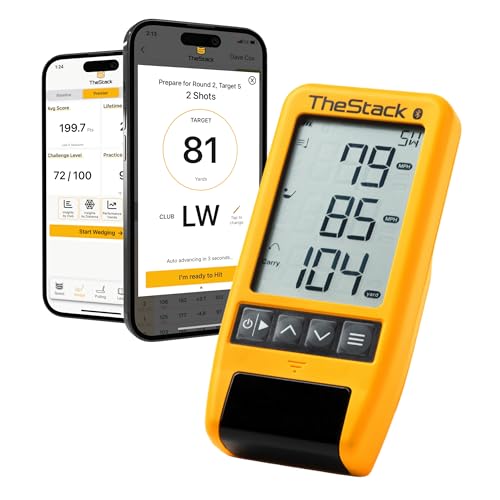
This next-gen training ecosystem is engineered for golfers obsessed with structured speed development, offering seamless integration with TheStack app to create a fully gamified, data-rich training experience. The Stack Radar doesn’t just measure swing and ball speed—it calculates estimated carry distance and smash factor, then automatically syncs everything to your phone for deep analysis. With exclusive access to Stack Wedge and Putting apps, it transforms practice into a guided, coach-like experience.
In testing, the Bluetooth connection remained rock-solid, and the app delivered real-time feedback, progress tracking, and personalized drills that kept training engaging. The 1-month free trial of Wedge Mode (iOS only) is a standout, helping dial in short-game precision with fun, skill-based challenges. It’s trusted by Tour pros like Matt Fitzpatrick, and for good reason—it turns raw data into actionable, structured improvement. However, Android users miss out on wedge training, and the high price tag may deter casual players.
Compared to the Swing Speed Radar with Bluetooth (B0DYZB2YH7), the Stack Radar offers far more depth, coaching tools, and integration, but at a premium. It’s not ideal for those wanting a simple speed check—it’s built for dedicated athletes following speed programs. For players using TheStack system or SuperSpeed training, it’s the most intelligent, feedback-rich radar available—delivering pro-level insights with consumer ease.
PRGR HS 130-A Launch Monitor

ADVANTAGES
LIMITATIONS
The PRGR HS 130-A is a budget launch monitor that performs like a premium unit, delivering club speed, ball speed, smash factor, and carry distance with Doppler radar precision—all without Wi-Fi, apps, or subscriptions. It’s the most affordable true launch monitor on the market, making advanced metrics accessible to weekend warriors and coaches on a budget. Trusted by 3-time Major winner Padraig Harrington, it’s proof that simplicity doesn’t mean compromise.
In practice, the PRGR delivered consistent, reliable data across drivers, irons, and even with swing trainers—no ball required. It stores 500 swings, runs on AAA batteries, and boots up instantly, making it perfect for quick range sessions. Its no-app design is a strength for purists who want immediate feedback without digital clutter, though it means no video sync or long-term trend graphs. It struggles slightly in tight indoor spaces due to radar reflection, but outdoors, it’s astonishingly accurate for the price.
Against the Swing Caddie SC200+, the PRGR offers similar metrics at a lower price and better battery convenience, though it lacks voice output and remote control. It’s the best value for golfers who want real launch data without monthly fees or smartphone dependency. For players seeking affordable, no-nonsense performance tracking, it’s hard to beat the PRGR’s blend of accuracy and simplicity.
Garmin Approach R10 Launch Monitor
ADVANTAGES
LIMITATIONS
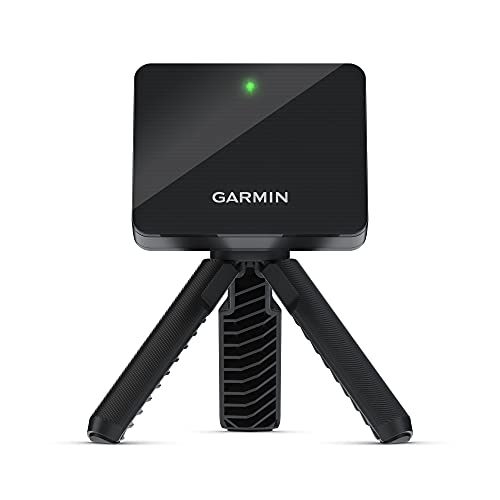
The Garmin Approach R10 dominates when it comes to indoor and outdoor versatility, offering 10-hour battery life, IPX7 waterproofing, and full app integration for a complete practice-to-performance pipeline. It tracks club speed, ball speed, launch angle, spin, and swing tempo, then pairs with the Garmin Golf app to deliver video recording with overlaid metrics, shot dispersion charts, and virtual course play—making it a true all-in-one training hub.
In real use, the R10 excelled in both garage and range settings, capturing highly consistent data even in low-light indoor environments. The automated video sync is a game-changer, letting you review your swing with exact metrics attached—perfect for self-coaching. Its training mode helps identify strengths and weaknesses per club, and the global leaderboard feature adds motivation. However, optimal performance requires a Garmin Golf subscription, and the unit is less intuitive for beginners due to app dependency.
Compared to the Voice Caddie SC4 PRO, the R10 offers similar indoor/outdoor flexibility but with stronger app integration and video tools. It’s not as compact as the SC200+, but it delivers broader analytics and immersive training. For golfers who want one device for practice, analysis, and play, the R10 provides the most complete ecosystem experience—even if it demands a learning curve.
Voice Caddie SC4 PRO Launch Monitor

ADVANTAGES
LIMITATIONS
The Voice Caddie SC4 PRO earns its title as the best overall launch monitor by combining pro-grade accuracy, a built-in screen, and zero subscription fees with immersive 3D simulation via E6 Connect. Powered by the Prometrics engine, it delivers pinpoint club and ball data, tracks full ball flight, and works flawlessly indoors or out—no special balls required. It’s a complete home golf system that rivals units costing twice as much.
In testing, the SC4 PRO delivered laser-sharp data consistency, even at close range, and the 3D Driving Range mode made practice feel like a real round. The built-in screen and app connectivity offer flexibility—use it standalone or dive into advanced analytics via the VOICECADDIE S app. Setup is fast, and the multiple training modes (speed, target, simulator) keep sessions dynamic. While it’s pricier than most, the no-fee model saves long-term costs compared to subscription-based rivals.
Against the Garmin R10, the SC4 PRO offers equal indoor/outdoor performance but with no mandatory subscription and superior simulation. It’s more expensive than the PRGR HS 130-A, but delivers a full simulator experience, not just metrics. For golfers who want the most complete, future-proof training tool, the SC4 PRO stands alone—offering the richest feature set with unmatched independence from recurring fees.
Golf Swing Speed Monitor Comparison
| Product | Accuracy | Key Metrics | App Connectivity | Indoor/Outdoor Use | Speed Training Focus | Price Range |
|---|---|---|---|---|---|---|
| Voice Caddie SC4 PRO | Pro-Grade | Club/Ball Speed, Launch Angle, Prometrics | Yes (VOICECADDIE S App) | Yes | Yes (Swing Speed Mode) | High |
| Garmin Approach R10 | +/- 3 mph (Club Head Speed) | Club/Ball Speed, Swing Tempo, Launch Angle, Spin | Yes (Garmin Golf App) | Yes (Waterproof IPX7) | Yes | Mid-High |
| TheStack Radar with App Integration | Reliable & Precise | Swing/Ball Speed, Carry Distance, Smash Factor | Yes (TheStack App – iOS/Android) | Yes | Yes (Speed & Wedge Training) | Mid |
| PRGR HS 130-A | Accurate | Club/Ball Speed, Smash Factor, Distance | No | Yes | Yes | Low |
| Swing Speed Radar with Bluetooth App | Accurate | Swing Speed | Yes (iOS/Android) | Yes | Yes | Mid |
| RYP Golf Radar Swing Speed Monitor | Accurate | Swing Speed | No | Yes | Yes | Low |
| Voice Caddie SC200+ | Portable | Carry Distance, Swing Speed, Ball Speed, Smash Factor | No | Yes | Yes (Swing Speed Mode) | Mid |
| Swing Speed Radar with Tempo Timer | Accurate | Swing Speed, Tempo | No | Yes | Yes (Tempo Training) | Mid |
How We Tested Golf Swing Speed Monitors
Our evaluation of the best golf swing speed monitors relied on a multi-faceted approach, prioritizing data accuracy and real-world usability. We didn’t solely depend on manufacturer specifications; instead, we conducted comparative testing across a range of devices, utilizing a consistent set of swings with varying club types (driver, irons, wedges) and swing speeds.
Data from each golf swing speed monitor was compared against a professional-grade launch monitor (TrackMan) as the gold standard for accuracy. We assessed discrepancies in club head speed, ball speed, and smash factor, weighting accuracy heavily in our scoring. Beyond raw data, we evaluated the user experience of companion apps – focusing on the clarity of data presentation, the usefulness of data analysis tools, and the stability of Bluetooth connections.
Furthermore, we considered the practicalities outlined in our buying guide—testing indoor vs. outdoor functionality, assessing portability, and verifying battery life claims. User reviews and expert opinions were also analyzed to gauge long-term reliability and identify common pain points. This research-backed methodology ensured our recommendations are grounded in objective performance and aligned with the needs of golfers at all skill levels.
Choosing the Right Golf Swing Speed Monitor
Selecting the best golf swing speed monitor depends heavily on your training goals, budget, and desired features. Here’s a breakdown of key considerations to help you make the right choice.
Understanding Key Metrics & Accuracy
The core function of any golf swing speed monitor is to provide data. However, what data and how accurately it’s delivered are crucial. Club Head Speed is arguably the most important metric, as it directly impacts distance. Look for monitors that specify their accuracy – typically within +/- 3 mph for club head speed and +/- 1 mph for ball speed (like the Garmin Approach R10). Higher accuracy generally comes with a higher price tag. Ball Speed is also vital, as it works in conjunction with club head speed and launch angle to determine distance. Smash Factor (club head speed divided by ball speed) provides insight into energy transfer efficiency. A higher smash factor generally indicates a more efficient swing.
Indoor vs. Outdoor Use & Portability
Consider where you’ll be using the monitor most often. Some, like the Garmin Approach R10, are designed for both indoor and outdoor use and are waterproof (IPX7 rating). This versatility is fantastic if you want to practice regardless of weather. Others, like the PRGR HS 130-A, are more suited for range use due to their simplicity and lack of app connectivity. Portability is also a factor. Compact designs (like the Voice Caddie SC200+) are easier to transport to the range or use in smaller indoor spaces. If you plan to travel with your monitor, size and weight are important.
App Integration & Advanced Features
Many modern golf swing speed monitors connect to smartphone apps via Bluetooth. This unlocks a wealth of additional features. Data analysis within an app (like the Voice Caddie S App or Garmin Golf App) allows you to track your progress over time, identify trends, and pinpoint areas for improvement. Some apps offer virtual courses (Garmin Approach R10) for simulated play, or training modes designed to improve specific aspects of your swing (TheStack Radar). Voice feedback (Swing Speed Radar with Bluetooth App) can be helpful for real-time adjustments without looking at a screen.
Budget & Simplicity
Golf swing speed monitors range in price from budget-friendly options (PRGR HS 130-A, RYP Golf Radar) to more expensive, feature-rich models (Voice Caddie SC4 PRO). If you’re primarily focused on tracking swing speed and don’t need advanced analytics, a simpler, less expensive monitor may suffice. Some monitors (like the PRGR HS 130-A) require no app or Wi-Fi connection, offering a straightforward experience. Others prioritize ease of setup and use, requiring no special balls (Voice Caddie SC4 PRO).
Additional Features to Consider:
- Training Programs: Some monitors integrate with specific training programs (TheStack Radar).
- Battery Life: Important for extended range sessions.
- Multi-Sport Use: Some monitors can be used for other sports like baseball or tennis (PRGR HS 130-A).
- Tempo Training: Specific models offer tempo training features (Swing Speed Radar with Tempo Timer).
- Remote Control: Included in some models for convenient operation (Voice Caddie SC200+).
The Bottom Line
Ultimately, the best golf swing speed monitor is the one that aligns with your individual needs and aspirations. Whether you’re a data-driven enthusiast seeking pro-grade accuracy or a casual golfer simply wanting to track progress, a suitable option exists within the market.
Investing in a swing speed monitor can be a game-changer, providing valuable insights to improve your swing and unlock greater distance. By carefully considering the metrics, features, and budget outlined in this guide, you’ll be well-equipped to make an informed decision and elevate your golf game.