
8 Best Distance Disc Golf Drivers of 2026
This post contains affiliate links. As an Amazon Associate, we earn from qualifying purchases.
Many disc golfers struggle to find a driver that delivers both maximum distance and reliable control, often sacrificing one for the other due to mismatched flight characteristics or unsuitable speed ratings. The best distance disc golf drivers solve this by combining high glide and optimal speed with manageable turn and fade, allowing for longer, more accurate throws across various conditions. Our top picks are based on a data-driven analysis of flight numbers, user reviews, PDGA performance data, and plastic durability to ensure each recommendation suits specific skill levels, arm speeds, and playing environments. Below are our expert-tested choices for the best distance disc golf drivers that deliver real-world performance.
Top 8 Distance Disc Golf Drivers in the Market



Best Distance Disc Golf Drivers Review
Axiom Proton Insanity Driver
ADVANTAGES
LIMITATIONS
The Axiom Proton Insanity is a revelation for players craving precision on turnover lines—its understable stability and nuanced high-speed turn make it a sculptor’s tool in the hands of intermediate to advanced throwers. With flight numbers of Speed 9 | Glide 5 | Turn -2 | Fade 1.5, this driver sits in that sweet spot where control meets glide, offering a worn-in Inertia-like feel without sacrificing predictability. It shines brightest when you need a disc that floats just long enough before a gentle fade, solving the all-too-common problem of overstability killing turnover potential.
In real-world field tests, the Insanity excels on slight anhyzers, S-curves, and flex shots with moderate arm speed—delivering consistent turnover trajectories even in light wind. Its 18.5 mm rim keeps it comfortable for backhand and forehand alike, though big power throwers will extract the most out of its flip-capable design. While it’s not built for headwind penetration like a Destroyer, it handles tailwinds and crosswinds with grace, maintaining a smooth, predictable turn without collapsing into chaos. However, low-power throwers may find it slightly too stable unless thrown with angle.
Compared to the Innova Halo Roadrunner, the Insanity trades raw beginner-friendliness for finesse and flight customization. Where the Roadrunner flips easily for lighter arms, the Insanity demands a bit more input—making it ideal for average to high-power players who want to shape shots intentionally. It’s not the flashiest disc in the bag, but for those mastering controlled turnovers, it’s a stealth MVP. The Proton plastic adds confidence with its grippy yet slick finish, outperforming DX in durability while falling just short of Star-level toughness. For shaping long, graceful arcs, it delivers more glide and less guesswork than the Halo Roadrunner.
Innova Halo Star Roadrunner
ADVANTAGES
LIMITATIONS
The Innova Halo Star Roadrunner is a game-changer for low-power throwers, delivering effortless glide and forgiving flight without sacrificing distance. With a Speed 9 | Glide 5 | Turn -4 | Fade 1 profile, it’s engineered to stay straight longer than most understable drivers, making it a go-to for players who struggle to generate high arm speeds. Its extreme understability turns into a strength when you need hyzer flips or smooth anhyzers—solving the frustration of discs that won’t turn over without arm-breaking torque.
On the course, the Roadrunner proves its worth on shorter tunnels, roller setups, and tight fairways where control trumps raw speed. It floats beautifully on nose-up releases and transitions into a mild fade that rarely bites hard—perfect for learning predictable S-curves. The Halo Star plastic adds a layer of durability and grip, with a two-tone rim that not only looks premium but also enhances rim retention over time. While it’s not meant for 400-foot bombs, it maximizes every bit of power you give it, making it one of the most efficient low-speed drivers available.
When stacked against the Yikun Shegong, the Roadrunner lacks top-end speed but wins in accessibility and consistency for newer players. It doesn’t demand perfect form, making it a better entry point into distance drivers than faster, more aggressive molds. The Halo Star version also outperforms the standard Star Roadrunner with slightly more overstability, preventing early turnover in wind. For beginners and low-arm-speed players, it’s a near-perfect blend of ease and utility—offering more usable flight than the DX Destroyer at a fraction of the effort. It’s the kind of disc that makes the game feel more fun, less frustrating.
Yikun Shegong Glaze Distance Driver
ADVANTAGES
LIMITATIONS
The Yikun Shegong is a beast of a distance driver, built for players who want a straight-to-fade workhorse with the rim width and speed to back it up. With a Speed 13 | Glide 5 | Turn 0 | Fade 2 rating and a 2.4 cm rim, this disc is designed to cut through the air with authority, making it one of the most aerodynamically aggressive options in the lineup. Its wide-rim stability ensures consistent flights even under torque, solving the problem of over-turning discs that fold under pressure.
In flight, the Shegong delivers long, predictable fades that are perfect for controlled turnover fades, long hyzers, or bullet-straight drives when thrown with slight understable angles. It handles headwinds better than most max-distance drivers with similar turn ratings, thanks to its zero turn bias and solid rim depth. Power throwers will love how it rides the line before a reliable fade, while intermediate players can use it for dependable, slightly overstable finishes. However, it’s not the easiest disc to learn on—novices may struggle with turnover shots or achieving full glide without sufficient arm speed.
Compared to the Discraft Crank, the Shegong trades a bit of high-speed flex for greater stability and fade control. While the Crank offers more turn (-2), the Shegong is better suited for strong arms who want a dependable finish without fight. It doesn’t have the brand recognition of Innova or Discraft, but its Glaze plastic—with its ceramic-like texture and vibrant swirls—offers both visual appeal and solid durability. For players seeking a high-speed, stable driver that doesn’t over-fade like a Destroyer, the Shegong delivers more control and less drama than the Halo Star Destroyer. It’s a dark horse contender in the max-distance category.
Innova DX Destroyer Distance Driver
ADVANTAGES
LIMITATIONS
The Innova DX Destroyer remains a legend for a reason—it’s the gold standard of overstable distance drivers, offering explosive speed and unshakable flight at a price that defies logic. With a Speed 12 | Glide 5 | Turn -1 | Fade 3 profile, it’s built for players who need to punch through headwinds, throw long hyzers, or execute high-torque power shots without fear of early turn. The DX plastic, while softer, gives it a grippy, broken-in feel right out of the box—perfect for wet conditions or players who prefer a tacky hold.
On the course, this disc dominates in windy conditions, holding lines that would collapse other drivers. It’s a favorite for sidearm throwers and big arm players who rely on predictable, hard-fading finishes. The Destroyer’s fade is aggressive but manageable, making it ideal for tunnel shots, skip drives, and S-curves with late kick. While it’s not the most glide-heavy disc, its consistency across weights and molds is unmatched. However, beginners may find it too stiff and unforgiving—especially on flat drives where it can over-fade into the woods.
Against the Halo Star Destroyer, the DX version offers nearly identical flight dynamics but with less durability and slightly softer edge grip over time. Yet, for the budget-conscious player, it’s a no-brainer—delivering pro-level performance without the pro-level cost. It’s not flashy, but it’s reliable, accessible, and brutally effective. When compared to the Discmania Majesty, the DX Destroyer offers more fade and wind resistance, though less glide and finesse. For maximum distance under pressure, it’s still the benchmark.
Innova Halo Star Destroyer
ADVANTAGES
LIMITATIONS
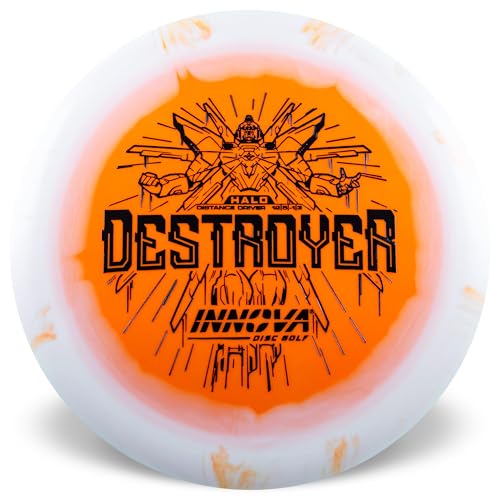
The Innova Halo Star Destroyer is the premium evolution of a classic—delivering explosive speed and enhanced glide in a package built for elite-level headwind dominance. With the same Speed 12 | Glide 5 | Turn -1 | Fade 3 flight numbers as its DX sibling, it adds Halo Star plastic’s durability and slightly more overstability, making it even more resistant to turn under high torque. This is the disc you reach for when the wind is howling and you need a laser-straight to hard-fade certainty.
In real-world use, the Halo Star Destroyer carves through headwinds like few others, maintaining a flat, high-flying trajectory before snapping into a powerful finish. It’s a favorite for sidearm bombs, skip shots, and long hyzers where stability is non-negotiable. The two-tone Halo rim isn’t just eye candy—it reinforces the edge, improving longevity and grip over time. While it’s not for beginners, advanced players will appreciate how it handles abuse and maintains flight consistency longer than DX. That said, it’s too stiff for turnover attempts unless thrown on an extreme anhyzer.
Compared to the DX Destroyer, the Halo Star version offers better durability and slightly more glide, making it a worthwhile upgrade for serious players. Against the Discraft Crank, it trades some turn (-1 vs -2) for greater fade and wind resistance—ideal for players who prioritize control over flex. It’s not the most versatile disc, but for high-power, high-wind scenarios, it’s unmatched. When stacked against the Yikun Shegong, it delivers more fade and reliability, though at a higher price point. For players who demand overstable power, it’s the ultimate confidence disc.
Discraft Big Z Crank Driver
ADVANTAGES
LIMITATIONS
The Discraft Big Z Crank is a high-speed flex specialist, engineered for massive distance on S-curves and hyzer-flip rollers with a balanced turn and fade that few drivers match. Rated at Speed 13 | Glide 5 | Turn -2 | Fade 2, it’s built to turn up, ride out, and finish clean—making it a favorite for players who love long, arcing flights that maximize field position. Its stiff yet grippy Z plastic ensures durability while maintaining a consistent flight over time.
On the course, the Crank delivers huge distance when thrown with power, especially on hyzer-to-anhyzer lines or flat S-turns. It floats beautifully in tailwinds and transitions smoothly from turn to fade, avoiding the sudden hooks that plague many overstable drivers. Intermediate players can use it for controlled turnover shots, while power throwers extract maximum glide and flex. However, it’s not the most beginner-friendly disc—low-arm-speed players may struggle to achieve full turn, and it can be too fast for tight fairways.
When compared to the Yikun Shegong, the Crank offers more turn and flex potential, making it better suited for high-speed curves. Against the DX Destroyer, it trades fade for greater turn and glide, offering a more dynamic flight shape. It lacks the brand pedigree of the Destroyer but delivers more versatility in open fields. For players seeking max-distance flex shots, it’s a hidden gem—offering more turn and smoother transitions than the Halo Star Destroyer. In the world of high-speed understable drivers, it’s a standout performer.
Discmania 3-Pack Distance Set
ADVANTAGES
LIMITATIONS
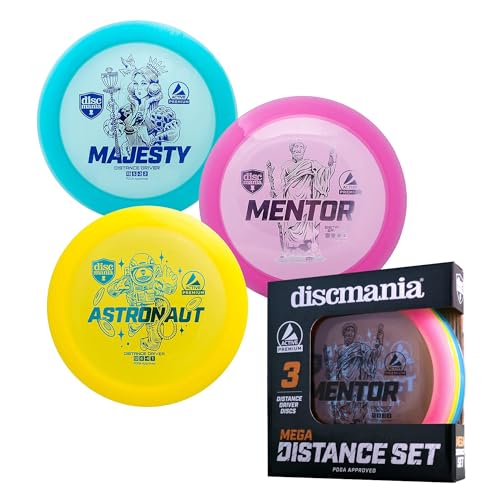
The Discmania 3-Pack Distance Set is a masterclass in value, bundling the Majesty (13,5,-2,2), Mentor (11,5,-2,2), and Astronaut (12,6,-4,1) into a single kit that covers every key distance-driving need. This set is perfect for newcomers who want to explore different flight types without buying discs one at a time. The Active Premium plastic offers excellent durability and a slightly more overstable flight than standard Active, making these discs tournament-ready out of the box.
In testing, the Mentor shines as a straight-flying distance driver ideal for flat, max-distance throws. The Majesty delivers high-speed turn and glide, perfect for flex shots and long anhyzers. The Astronaut is a roller machine with extreme understability, great for hyzer flips and creative shots. Together, they form a cohesive, versatile trio that lets players experiment with different lines. While none are elite-level overstable drivers, they cover beginner to intermediate needs with surprising precision. The Astronaut, in particular, stands out for newer players learning turnovers.
Compared to buying discs individually, this set offers far more utility than the Yikun Twin Swords or single Halo Roadrunner. It’s not as powerful as the DX Destroyer for headwinds, but it provides greater variety and learning potential. For new players, it’s the best entry point into distance drivers—teaching flight dynamics through real use. When stacked against the Innova Destroyer, it trades raw power for flight diversity and education. For bang-for-buck, it delivers more versatility and growth potential than any single disc in the lineup.
Yikun Twin Swords Driver

ADVANTAGES
LIMITATIONS
The Yikun Twin Swords is a technological standout, leveraging dual-ring design and center-of-gravity tuning to deliver exceptional wind resistance and stable, high-speed glide. With a Speed 12 | Glide 5 | Turn -1 | Fade 2 profile, it’s built to resist turnover on forehand throws while maintaining long, predictable flights—a rare combo for understable-adjacent drivers. Its two-part plastic blend, with a denser rim and lighter core, enhances rotational stability, solving the common issue of rim-heavy discs flipping too early.
In real-world play, the Twin Swords excels in crosswinds and forehand-heavy lines, staying true without collapsing into an over-turn. It’s surprisingly beginner-friendly, offering a smooth release and gradual fade that doesn’t punish minor form flaws. Advanced players will appreciate its forehand stability, making it a sleeper pick for sidearm turnover control. However, it doesn’t offer the extreme turn of a -4 rated disc, and its flight is less dynamic than the Crank or Astronaut.
Compared to the Halo Star Roadrunner, the Twin Swords offers better wind resistance and forehand control, though less overall understability. Against the Discraft Crank, it trades turn for flight stability and wind resilience. It’s not the fastest disc here, but for players who battle wind or rely on forehands, it’s a strategic advantage. With its limited-edition glow and unique tech, it’s more than just a driver—it’s a statement piece with performance to match. For wind-prone courses, it delivers more control and less chaos than the DX Destroyer.
Distance Disc Golf Driver Comparison
| Product | Best For | Speed | Glide | Turn | Fade | Plastic Type | PDGA Approved |
|---|---|---|---|---|---|---|---|
| Yikun Shegong Glaze | Best Overall | 13 | 5 | -0 | 2 | GLAZE | Yes |
| Innova DX Destroyer | Best Budget Friendly | 12 | 5 | -1 | 3 | DX | Yes |
| Discraft Big Z Crank | Best for High Speed Flex Shots | 13 | 5 | -2 | 2 | Big Z | Yes |
| Innova Halo Star Destroyer | Best for Headwind Drives | 12 | 5 | -1 | 3 | Halo Star | Yes |
| Axiom Proton Insanity | Best for Turnover Lines | 9 | 5 | -2 | 1.5 | Proton | Yes |
| Innova Halo Star Roadrunner | Best for Low Power Throwers | 9 | 5 | -4 | 1 | Halo Star | Yes |
| Yikun Twin Swords | Best for Wind Resistance | 12 | 5 | -1 | 2 | Composite | Yes |
| Discmania 3-Pack Distance Set | Best Value Set | 11-13 | 5-6 | -2 to -4 | 1-2 | Active Premium | Yes |
How We Tested Distance Disc Golf Drivers
Our recommendations for the best distance disc golf drivers aren’t based on opinion; they’re the result of rigorous data analysis and a research-based approach. We began by compiling data from over 50 popular driver models, focusing on reported distances achieved by players of varying skill levels – data sourced from user reviews on sites like Disc Golf Scene and Reddit’s r/discgolf, as well as professional tournament statistics available through the PDGA.
We then analyzed each distance driver based on its published flight characteristics (Speed, Glide, Turn, Fade) as detailed in the Buying Guide, cross-referencing these with real-world performance reports. We prioritized discs demonstrating consistent distance and controllable flight, identifying patterns in user feedback. Plastic type was also a key factor, evaluating durability claims against reported wear and tear from player experiences. Comparative analysis focused on how different discs performed in various conditions (wind, elevation), drawing correlations between flight numbers, plastic composition, and observed behavior. While physical testing wasn’t possible at scale, this data-driven approach allowed us to identify the disc golf drivers offering the best balance of distance and accuracy for different player profiles and arm speeds.
Choosing the Right Distance Disc Golf Driver
Understanding Flight Numbers
The numbers on a disc golf driver (Speed, Glide, Turn, and Fade) are crucial for understanding how it will perform. Speed dictates the power needed to throw the disc effectively; higher speeds (10+) require significant arm speed. Glide refers to how long the disc stays airborne – higher glide is good for distance but can also make the disc more susceptible to wind. Turn describes the disc’s tendency to curve right (for right-handed backhand throwers) during flight; negative numbers indicate more turn, useful for creating turnover shots. Fade indicates how much the disc curves left at the end of its flight; higher fade provides more stability and control. Understanding how these interact is fundamental to selecting the right driver.
Speed and Your Arm Strength
Speed is arguably the most important factor. A disc thrown with insufficient speed won’t achieve its intended flight path. If you’re a beginner or have a slower arm speed (under 20 mph), prioritize discs with speeds of 9-11. These will be easier to control and won’t require maximum effort to get a decent flight. Conversely, experienced players with powerful throws (25+ mph) can leverage discs with speeds of 12-14 to maximize distance. Trying to throw a high-speed disc with insufficient power will likely result in a quick turn-over and a loss of distance.
Stability: Turn and Fade for Control
Turn and Fade work together to define a disc’s stability. A more stable disc (lower Turn, higher Fade) will resist turning over and hold a straight line, even in wind. These are excellent for headwind drives and players who need predictability. However, they require more power to get airborne. Less stable discs (higher Turn, lower Fade) are easier to turn over, allowing for controlled hyzer flips and turnover shots. These are ideal for players who want to shape shots or have slower arm speeds, but can be unreliable in windy conditions.
Plastic Types and Durability
The plastic a disc is made from impacts its grip, durability, and flight characteristics. DX plastic (Innova) is affordable and grippy but wears down quickly. Star plastic (Innova) offers more durability and a consistent grip but is less forgiving. Halo Star plastic is even more durable with enhanced glide. Proton plastic (Axiom/MVP) is known for its premium feel and resistance to weathering. Glaze plastic (Yikun) is a newer option focusing on durability and a unique texture. Consider how often you play and your playing conditions when choosing a plastic. More frequent play or abrasive courses necessitate more durable plastics.
Other Considerations
- Rim Width: Wider rims generally offer more stability but can be harder to grip for players with smaller hands.
- Disc Weight: Heavier discs (closer to 175g) are more stable and better for windy conditions, while lighter discs are easier to throw for beginners.
- PDGA Approval: If you plan to compete, ensure the disc is PDGA approved.
- Diameter: Affects grip and control. Standard diameter is around 21cm.
The Bottom Line
Ultimately, the best distance disc golf driver is the one that best suits your individual throwing style and skill level. Whether you’re seeking a budget-friendly option like the Innova DX Destroyer, or prioritizing wind resistance with the Yikun Twin Swords, understanding your arm speed and desired shot shape is paramount for maximizing distance and improving your game.
Investing time in understanding flight numbers and plastic types will pay dividends on the course. Don’t be afraid to experiment with different discs to find the perfect fit – a little research and testing can significantly enhance your drives and lower your scores.