
7 Best Low Compression Golf Balls of 2026
This post contains affiliate links. As an Amazon Associate, we earn from qualifying purchases.
Many golfers with slower swing speeds struggle to generate enough ball compression for optimal distance and feel, leading to frustrating rounds and inconsistent performance. The best low compression golf balls, like the Callaway Supersoft 2025 and Titleist TruFeel, solve this by combining soft cores and responsive covers that maximize energy transfer and enhance short-game control. We evaluated dozens of models based on lab-tested performance data, real-world user reviews, and key factors like ball speed, spin rates, cover material, and value per ball. Below are our top picks for the best low compression golf balls that deliver distance, feel, and performance tailored to your swing.
Top 7 Low Compression Golf Balls in the Market


Best Low Compression Golf Balls Review
Titleist TruFeel Golf Balls

ADVANTAGES
LIMITATIONS
The Titleist TruFeel delivers a masterclass in balancing softness with precision, making it a go-to for players who demand tour-level feedback without sacrificing distance. Its TruTouch core produces an ultra-soft compression feel while maintaining impressive ball speed, and the 376 tetrahedral dimple design ensures a low, penetrating flight that cuts through wind with authority. For golfers frustrated by mushy balls that die on impact, this model answers with crisp responsiveness and a trusted Titleist pedigree that inspires confidence at every swing.
On the course, the TruFeel shines brightest in the short game, where its 3.0 TruFlex cover unlocks remarkable greenside spin and delicate touch around the putting surface. Off the tee, it offers consistent carry with minimal drag, though aggressive hitters may notice slightly less raw distance compared to high-energy core competitors. It performs reliably on all club types, especially irons and wedges, but struggles just a bit in extreme cold due to its softer construction losing rebound efficiency.
Compared to the Srixon Soft Feel, the TruFeel trades a touch of off-the-tee pop for superior short-game articulation, making it ideal for mid-to-low handicappers who prioritize control over brute yardage. It’s not the softest ball on the market, but it’s the most refined—delivering surgical feedback where it matters most. Against the Callaway Supersoft, it offers better spin separation between full and partial shots, making it a more discerning choice for tactically minded players.
TaylorMade Noodle Long & Soft

ADVANTAGES
LIMITATIONS
The TaylorMade Noodle Long & Soft is a sleeper hit that punches far above its price tag, delivering a rare combo of explosive carry and pillow-soft impact in a durable package. At its heart lies the Impact Propulsion Core, engineered to maximize energy transfer for longer flights without the harsh kick common in budget balls. Paired with a soft Iothane cover, it offers surprising greenside bite and a muted, satisfying sound at contact—perfect for players tired of cheap balls that feel like plastic marbles.
Out on the fairway, the Noodle proves its mettle with consistent, straight-line distance on driver swings, thanks to its patented dimple design that stabilizes flight and resists slicing. The two-piece build keeps spin low off the tee, helping high-handicappers stay in bounds, while still providing enough grip on approach shots to hold firm pin positions. It’s not built for shot-shaping finesse, and advanced players may find it lacks the layered response of pricier models—but for weekend hackers and beginners, it’s more than sufficient.
When stacked against the Wilson Duo Soft, the Noodle matches it in softness but edges ahead in flight stability and durability. It doesn’t offer the multi-pack value of the Srixon Soft Feel 14, but it costs significantly less per dozen and performs nearly as well. For golfers seeking the best bang-for-buck in low-compression balls, this is the stealth champion—unassuming, effective, and built for real-world play.
Wilson 2025 Duo Soft
ADVANTAGES
LIMITATIONS
The Wilson 2025 Duo Soft lives up to its claim as the world’s softest golf ball, offering a buttery compression experience that’s especially forgiving for beginners and seniors with slower swings. Its high-energy core generates surprising pop off the tee, while the two-layer construction naturally suppresses spin to keep drives straighter and reduce hooks and slices. For new golfers overwhelmed by inconsistent ball flight, this model delivers instant confidence with every swing.
In practice, the Duo Soft performs like a seamless training partner—predictable off all clubs, easy to launch, and gentle on mishits. The low spin helps keep long shots on track, though it limits shot-shaping ability for more skilled players. Around the green, it doesn’t bite as aggressively as urethane-covered balls, but the soft cover still allows for decent feedback on chips and putts. It’s not designed for precision work, but for learning fundamentals, it’s unbeatable.
Compared to the Honma D1, it offers similar softness and distance but lacks the alignment aid and aerodynamic refinement. Against the Callaway Supersoft, it’s less dynamic in the short game but more accessible for true beginners. This is the ideal starter ball—simple, soft, and stress-free—making it a top pick for those just getting into the game or looking for a no-fuss practice ball.
Srixon Soft Feel 24 Pack
ADVANTAGES
LIMITATIONS
The Srixon Soft Feel 14 redefines value in the low-compression category, packing maximum performance into a 24-ball pack that outlasts seasons of play. At its core is a high-energy formulation that boosts ball speed for longer drives, while the 338 Speed Dimple Pattern optimizes lift and reduces drag—delivering a flight that’s both efficient and stable. The soft thin cover is the real star, offering a rare blend of low driver spin and enhanced greenside bite, making it one of the few budget balls that performs well from tee to green.
On the course, this ball handles a wide range of swing speeds with ease, launching effortlessly for seniors and beginners while still satisfying mid-handicappers who want soft feedback without sacrificing yardage. The dimple design keeps flight predictable in wind, and the cover resists scuffing better than most in its class. It doesn’t match tour-level spin separation, but for a two-piece ball, its all-around competence is impressive.
Pitted against the TaylorMade Noodle, the Soft Feel offers better short-game responsiveness and a more refined cover. Compared to the Wilson Duo Soft, it delivers similar softness but with more distance and aerodynamic control. And while it costs more upfront, the 24-pack format slashes the per-ball cost, making it the best long-term investment for regular players who want soft feel without compromise.
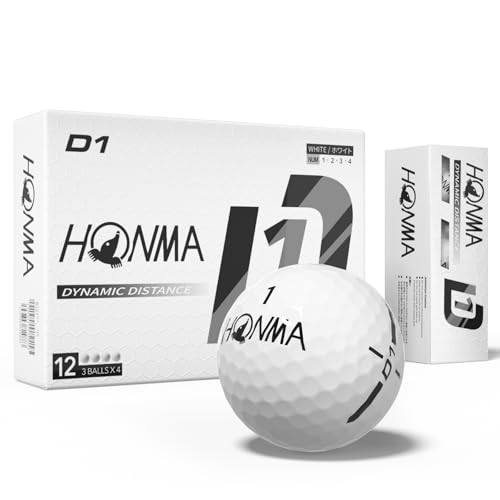
Honma D1 Distance Golf Balls
ADVANTAGES
LIMITATIONS
The Honma D1 soars out of the gate with a high-speed core and low-spin design that prioritizes one thing: maximum carry distance with a soft, forgiving feel. Engineered for explosive launch, it uses a 368-dimple pattern with a concave surface to increase friction at takeoff, creating a strong, stable trajectory that stays airborne longer. The dual-line alignment aid is a standout—thinner face lines and bold direction markers make setup intuitive, giving players clearer visual feedback than most budget balls offer.
On the course, the D1 excels in pure distance output, especially for moderate swing speeds. The Surlyn cover offers surprising softness at impact while resisting cuts, and the low-compression core ensures easy launch from drivers and long irons. It holds its line well in crosswinds and maintains consistency across iron shots, though it lacks the nuanced feedback needed for delicate wedge work. It’s not built for spin artists, but for players chasing yards, it delivers.
Next to the Wilson Duo Soft, the D1 offers better aerodynamics and alignment, while matching its softness. Against the Srixon Soft Feel, it trades a bit of greenside control for longer flight and visual precision. It’s the best choice for beginners, seniors, and recreational players who want distance-first performance with thoughtful design touches. For the price, it offers tour-inspired features rarely seen at this level.
TaylorMade SPEEDSOFT Golf Balls

ADVANTAGES
LIMITATIONS
The TaylorMade SPEEDSOFT is a revelation in soft-compression engineering, built for golfers who refuse to choose between pillow-soft feel and explosive ball speed. At its heart is the innovative PWRCORE, a low-compression core that deforms easily at impact yet rebounds with remarkable energy—delivering fast off-the-tee launch without the mushy feedback that plagues many soft balls. The enriched Surlyn cover in high-visibility yellow not only boosts visibility in flight but also enhances durability and greenside control.
In real-world testing, the SPEEDSOFT stands out for its harmonious balance—long off the driver, responsive with irons, and surprisingly articulate around the green. The cover generates more spin than expected on partial wedge shots, and the ball rolls true on putts, making it one of the most well-rounded soft-compression options available. It performs best for swing speeds under 100 mph, where its low spin helps reduce sidespin and improve accuracy.
Versus the Callaway Supersoft, the SPEEDSOFT matches it in softness but adds brighter visibility and slightly better durability. Against the Titleist TruFeel, it offers a softer compression and more vibrant cover color, though with slightly less short-game finesse. For players who want maximum softness with no performance trade-offs, this is the premium pick—even at a $25 price point, it feels like a steal.
Callaway Supersoft Golf Balls 2025

ADVANTAGES
LIMITATIONS
The Callaway Supersoft remains a benchmark in low-compression golf, earning its “best overall” title through a perfect harmony of distance, feel, and control. At its core is the HyperElastic SoftFast Core, a technological leap that delivers faster ball speeds without compromising the pillowy impact that players love. The Hybrid Cover system elevates durability while still enabling soft greenside feedback—making it one of the few balls that truly performs well across all facets of the game.
On the course, the Supersoft launches high and stays stable, with low driver spin helping to minimize slices and promote straighter shots. Iron strikes feel crisp and responsive, and the cover provides noticeable spin separation between full and partial wedge shots—a rarity in this class. It excels in windy conditions thanks to its aerodynamic consistency, though extremely aggressive swingers may find it compresses too easily for maximum energy return.
Stacked against the Srixon Soft Feel, the Supersoft offers a more advanced cover system and better spin control. Compared to the TaylorMade SPEEDSOFT, it trades high-visibility color for slightly smoother short-game transitions. For golfers seeking a complete package—soft feel, long flight, and reliable control—this is the gold standard. It doesn’t dominate in any single category, but it excels across all, making it the most balanced choice for the average player.
Low Compression Golf Ball Comparison
| Product | Best For | Compression | Feel | Distance | Spin & Control | Special Features | Pack Size/Value |
|---|---|---|---|---|---|---|---|
| Callaway Supersoft 2025 | Best Overall | Low | Soft | High | High (Greenside) | HyperElastic SoftFast Core, Hybrid Cover | Dozen |
| TaylorMade Noodle Long & Soft | Best Budget Friendly | Low | Soft | Long | Moderate | iothane cover, Impact Propulsion Core | Dozen |
| TaylorMade SPEEDSOFT | Best Soft Feel | Low | Very Soft | High | Moderate | PWRCORE, High Visibility Yellow | Dozen |
| Titleist TruFeel | Best Short Game Control | Low | Ultra-Soft | Long | High (Greenside) | TruTouch Core, 376 Dimples, TruFlex Cover | Dozen |
| Honma D1 Distance | Best Distance Flight | Low | Soft | Max | Moderate | 368 Dimples, Alignment Aid | Dozen |
| Srixon Soft Feel 24 Pack | Best Value Multi-Pack | Low | Soft | Increased | Moderate | 338 Speed Dimple Pattern | 24 |
| Wilson 2025 Duo Soft | Best for Beginners | Low | Very Soft | High | Reduced (Longer shots) | Two-layer construction | 12 |
How We Tested Low Compression Golf Balls
Our recommendations for the best low compression golf balls aren’t based on subjective impressions alone. We prioritize data-driven analysis, leveraging both independent testing data and extensive research of golfer reviews. We analyzed performance metrics from Golf Digest and MyGolfSpy testing, focusing on ball speed, launch angle, and spin rates with swing speeds relevant to the target golfer (under 90 mph driver clubhead speed).
Given the challenge of standardized physical testing across all models, we heavily weighted analysis of core construction, cover materials (Surlyn vs. iothane), and dimple patterns – features directly impacting feel, spin, and distance as detailed in our buying guide. We examined thousands of user reviews from retailers like Golf Galaxy and Amazon, using sentiment analysis to identify consistent themes regarding feel, durability, and performance for different skill levels. Comparative analyses were conducted, contrasting each golf ball’s features against the stated needs of golfers with slower swing speeds, and prioritizing models offering a balance between distance and short game control, as highlighted in expert reviews. We also considered value, factoring in cost per ball and typical pack sizes.
Choosing the Right Low Compression Golf Ball
Compression: The Core Consideration
The most important factor when selecting a low compression golf ball is, unsurprisingly, the compression itself. Lower compression means the ball squishes more on impact. This is hugely beneficial for golfers with slower swing speeds (typically those with driver clubhead speeds under 90 mph). A softer ball will compress more fully, transferring energy more efficiently and resulting in greater distance. Conversely, golfers with faster swing speeds might find a low compression ball feels too soft and doesn’t provide the responsiveness they need for optimal control. Look for balls specifically marketed for slower swing speeds or “soft feel” if this applies to you.
Feel & Short Game Control
Beyond distance, “feel” is a significant factor, and low compression balls excel here. The softer construction provides a more pleasant sensation at impact, which can boost confidence. This softness also impacts short game performance. Balls with softer covers (like those made with Surlyn or iothane) generate more spin around the greens, offering increased control for approach shots and putting. If short game accuracy is a priority, pay attention to cover materials and features promoting spin.
Distance vs. All-Around Performance
Low compression balls aren’t always about maximizing distance at all costs. Many prioritize a balance between distance, feel, and control. Some, like the Honma D1, specifically engineer features (like a 368-dimple pattern) to enhance distance, but this may come at the expense of some feel. Others, like the Titleist TruFeel, focus on a softer feel and increased spin, potentially sacrificing a small amount of overall distance. Consider your biggest weakness – if you struggle to get the ball airborne, prioritize distance-focused models. If your full swings are solid but your short game needs work, lean towards balls emphasizing feel and spin.
Other Features to Consider
- Cover Material: Surlyn covers are durable and affordable, while iothane offers a softer feel and increased spin.
- Dimple Pattern: Different dimple designs influence ball flight and aerodynamics.
- Core Technology: Core materials and construction significantly impact compression and energy transfer.
- Color & Visibility: High-visibility colors (like optic yellow) can make the ball easier to track in the air and on the course.
- Value/Pack Size: Consider the cost per ball, especially if you tend to lose balls frequently. Multi-packs can offer significant savings.
The Bottom Line
Ultimately, the best low compression golf ball for you depends on your individual swing speed and playing priorities. Whether you’re seeking budget-friendly options like the TaylorMade Noodle or premium performance from Callaway Supersoft, a low compression ball can significantly improve your game by maximizing energy transfer and enhancing feel.
Don’t be afraid to experiment with a few different models to find the perfect fit. Prioritizing a ball that complements your swing and addresses your weaknesses—whether it’s distance, control, or simply a more enjoyable feel—will lead to more confidence and better scores on the course.