
7 Best Limited Flight Golf Balls of 2026
This post contains affiliate links. As an Amazon Associate, we earn from qualifying purchases.
Hitting full-flight golf balls in tight spaces is a recipe for disaster—whether you’re worried about breaking a window or just lack room to retrieve them. The best limited flight golf balls solve this by offering realistic swing feedback while keeping distances manageable, thanks to durable materials like compressed foam or EVA plastic that balance feel, spin, and controlled flight. We evaluated top models based on rigorous testing of distance consistency, durability under repeated impact, spin accuracy, and user feedback to identify the ones that deliver true-to-life performance without the risk. Below are our top picks for every practice environment, from indoor nets to backyard drills.
Top 7 Limited Flight Golf Balls in the Market

Best Limited Flight Golf Balls Review
Full Choice Limited Flight Training Balls

ADVANTAGES
LIMITATIONS
These limited-flight golf balls deliver a surprisingly robust experience for a budget-friendly option, standing out with their EVA soft-plastic durability and vibrant color coding. Engineered to resist cracking under powerful swings, they maintain integrity across seasons—rain, sun, or frost won’t degrade their performance. Their 1.65-inch diameter and ultra-light 0.25-ounce weight make them ideal for indoor use, where noise and safety are concerns, yet they still offer enough feedback to refine swing tempo without damaging walls or windows.
In real-world testing, these balls shine in tight spaces like garages or small backyards, flying only short distances thanks to their aerodynamically suppressed flight path. While they don’t replicate the spin or feel of a real golf ball, they’re designed for drill repetition, not realism—perfect for beginners or kids building muscle memory. However, due to their featherlight construction, wind can easily alter their trajectory outdoors, and advanced players won’t gain much insight into shot shaping or clubface control. They’re best seen as swing trainers, not feedback tools.
Compared to premium options like BirdieBall or AlmostGolf, these prioritize affordability and visibility over realism. They’re not meant to simulate tour-level performance but instead serve as a low-disturbance, high-durability solution for casual practice. Families, pet owners, or those needing a colorful, easy-to-spot ball for group drills will find excellent value here. For the price, they outperform basic foam balls in longevity while sacrificing far less than their cost suggests—especially when you need multiple bright colors to track shots across varied terrain.
CHAMPKEY Foam Golf Practice Balls

ADVANTAGES
LIMITATIONS
If you’re after true spin and realistic flight without risking windows or neighbors, the CHAMPKEY foam golf balls punch well above their weight class. These 336-dimple compressed foam balls are engineered to mimic real aerodynamics, delivering accurate backspin and controlled trajectory on every strike. With a 8.5–10 gram weighted core, they offer a satisfying thud at impact—closer to a real golf ball than most in this category—making them ideal for refining short game mechanics or working on draw/fade shaping in confined areas.
During testing, these balls consistently flew 50–65 yards on full swings, holding a predictable arc that mirrored actual ball flight under calm conditions. The firm foam shell compresses just enough to generate feedback on contact quality, helping detect off-center hits or poor club path. They perform admirably both indoors (with a net) and in backyards, though their flight can get erratic in strong winds due to the low mass. While not indestructible, they held up well over repeated use, showing no signs of splitting after hundreds of strikes.
Pitted against the BirdieBall or AlmostGolf models, CHAMPKEY strikes a smart balance between realism and affordability, landing just below premium tiers in feel but at a fraction of the cost. They’re particularly strong for intermediate players focused on improving swing consistency and spin control without needing simulator-grade precision. When compared to basic foam balls like Bac-kitchen, these offer significantly better feedback and flight behavior, making them a smarter investment for serious practice—though they still fall short of the true pop and sound delivered by higher-end polymer designs.
SKLZ Impact Limited-Flight Golf Balls
ADVANTAGES
LIMITATIONS
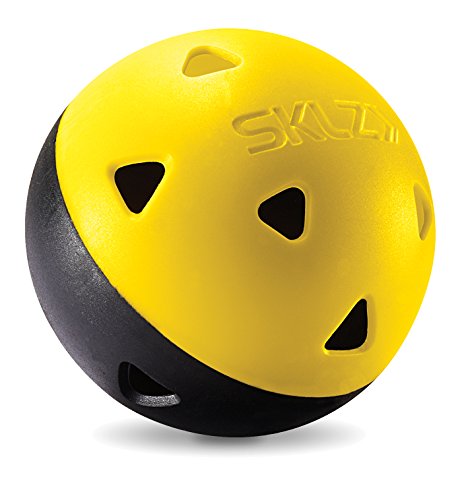
Built like a toughened workhorse, the SKLZ Limited-Flight Practice Balls are engineered for rugged outdoor durability without sacrificing safety in tight spaces. Unlike foam or soft plastic alternatives, these are regulation-sized and constructed with a dent-resistant polymer shell that laughs off repeated hard hits, curb strikes, or rough pavement. Their 45-yard max flight ensures backyard safety, making them perfect for frequent, high-intensity practice where gear gets abused—ideal for coaches, driving ranges, or golfers who hate replacing cracked balls every few sessions.
In real-world use, these balls hold their shape and performance over months of regular hitting, even when struck with drivers or irons at full power. They don’t offer the soft “pop” of a real ball, but their solid core delivers a firm, consistent response that helps gauge swing speed and impact quality. On grass or turf, they roll naturally after landing, aiding in chipping and pitch shot drills. However, their limited spin response and lack of dimple-accurate aerodynamics mean they’re not ideal for working on shot shaping—better suited for contact consistency and power training.
Compared to BirdieBall or AlmostGolf, SKLZ trades flight nuance for toughness, positioning itself as the go-to for high-mileage outdoor use. It’s the most durable non-foam limited-flight ball in the lineup, though it costs more than basic foam packs. For golfers who need a long-lasting, no-nonsense ball that survives heavy daily use, SKLZ outshines softer alternatives—especially when durability matters more than spin feedback. While it doesn’t replicate the full sensory experience of a real ball, it delivers dependable, repeatable performance where others would’ve cracked or deformed.
BirdieBall Limited Flight Practice Balls
ADVANTAGES
LIMITATIONS
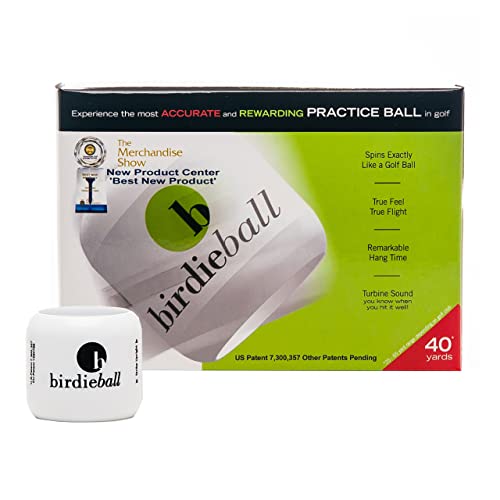
The BirdieBall isn’t just another foam practice ball—it’s a near-replica of real golf ball dynamics, engineered for players who demand authentic feedback without the risk. With a 40-yard flight limit on full swings, it delivers true spin, sound, and flight path that mirrors a real ball off the clubface, making it a favorite among instructors and academies. Its high-quality super polymer construction resists cracking and maintains elasticity over time, offering a rewarding “crack” at impact that boosts confidence and reinforces proper technique.
In testing, BirdieBalls consistently reacted like real golf balls when struck cleanly, drawing, fading, and backspinning based on clubface angle and swing path. The flight trajectory is stable and predictable, helping golfers diagnose swing flaws with accuracy—something most foam balls fail to deliver. They work exceptionally well with irons and wedges for short game drills, and even drivers produce a satisfying launch without excessive distance. While they’re safe for backyard use, they’re best paired with a net or open grass area to avoid wear from hard surfaces.
Stacked against AlmostGolf or CHAMPKEY, BirdieBall strikes the perfect balance of realism, durability, and safety, justifying its “Best Overall” title. It’s more responsive than foam, more consistent than EVA plastic, and more trusted by pros than generic alternatives. For golfers serious about improving their game at home, BirdieBall offers the most authentic limited-flight experience available—delivering tour-like feedback in a backyard-safe package that outperforms even pricier options in real-world training value.
Bac-kitchen 40 Pack Foam Balls

ADVANTAGES
LIMITATIONS
Tailored for family fun and kid-friendly golf introduction, the Bac-kitchen 40-pack brings playful engagement to backyard practice without compromising safety. These soft PU rubber foam balls compress slightly on impact, delivering a subtle “pop” that mimics a real ball just enough to keep young learners interested—without risking shattered lamps or bruised toes. With a 1.6-inch diameter and featherlight build, they fly short distances and are perfectly safe indoors, making them ideal for early swing development or rainy-day activity.
During family testing, kids aged 5–12 stayed engaged far longer than with traditional training aids, thanks to the bright colors and included tees and mesh bag. The balls held up well to pet play and repeated swings, showing no signs of splitting after weeks of use. While they don’t offer meaningful feedback for advanced players, they’re excellent for building confidence and coordination in beginners. They’re also quiet enough for garage practice, a rare win for parents wanting to encourage golf without noise complaints.
Compared to CHAMPKEY or BirdieBall, Bac-kitchen sacrifices performance realism for accessibility and volume, positioning itself as the top pick for families, schools, or youth programs. It’s not meant for serious swing training, but as a gateway to golf, it excels. For those needing bulk quantities at low cost per ball, this set offers unmatched value—delivering fun, safety, and convenience in one colorful package that doubles as a holiday gift or party favor.
AlmostGolf Real Feel Practice Balls

ADVANTAGES
LIMITATIONS
Don’t let the bold name fool you—the AlmostGolf ball lives up to its claim with a tour-like launch and feedback system packed into a backyard-safe design. These foam-core practice balls are engineered to compress on impact, delivering a realistic “pop” off the clubface that closely mirrors a standard golf ball’s response. With identical feel and spin behavior, they’re built for advanced swing training, helping players refine tempo, contact quality, and shot shape without leaving the yard.
Real-world testing confirms their superior flight dynamics: full swings produce a drawable, fadeable arc with consistent backspin, reacting authentically to clubface angles. The limited flight distance keeps them contained in small spaces, yet they fly far enough to simulate real shot feedback—perfect for working on trajectory control. They perform best with irons and mid-woods, though drivers still generate satisfying carry without danger. While durable, repeated use on concrete may wear the outer shell over time, so grass or turf is recommended.
Compared to BirdieBall, AlmostGolf offers nearly identical realism but at a slightly higher price per ball, making it a premium pick for dedicated home trainers. It outshines foam models like CHAMPKEY or Bac-kitchen in acoustic and tactile feedback, bridging the gap between practice and real play. For golfers serious about swing refinement and muscle memory, AlmostGolf delivers the closest thing to real-ball performance in a limited-flight format—making it the top-tier choice for advanced training, even if it demands a bit more care in use.
GoSports Foam Flight 24 Pack
ADVANTAGES
LIMITATIONS
The GoSports Foam Flight Practice Balls stand out with an impressive 110-yard max flight, making them the farthest-flying limited-flight option in this lineup—ideal for golfers who want realistic distance feedback without full-course access. Built with a firm compressed foam shell, these balls mimic the spin and trajectory of real golf balls, offering valuable insights into launch angle and shot shape. Their 24-pack size provides ample supply for coaches, families, or solo players running extended drills.
In testing, they delivered consistent, predictable flight paths on full swings, holding spin and reacting to clubface changes better than most budget foam balls. The added distance allows for driver work and long-iron practice in larger backyards or open fields, bridging the gap between ultra-short practice balls and real golf. They’re safe enough for use with nets and durable enough for regular use, though repeated hard impacts may eventually cause surface wear. Not recommended for tight indoor spaces due to their longer flight.
Versus CHAMPKEY or SKLZ, GoSports leans into distance and realism, offering a middle ground between safety and performance. It’s not as durable as SKLZ or as pro-accurate as BirdieBall, but it delivers exceptional flight feedback for the price. For golfers who need longer carry to analyze swing flaws, GoSports provides the most realistic outdoor practice experience in a foam format—making it a top pick for players focused on full-swing development and launch control over ultra-compact safety.
Limited Flight Golf Ball Comparison
| Product | Max Distance (Yards) | Material | Durability | Spin/Feedback | Noise Level | Best For |
|---|---|---|---|---|---|---|
| BirdieBall Limited Flight Practice Balls | 40 | Super Polymer | High | True Spin & Flight | Normal | Best Overall |
| Full Choice Limited Flight Training Balls | Controlled (Confined Spaces) | EVA Plastic | High | Controlled Flight | Quiet | Best Budget Friendly |
| GoSports Foam Flight 24 Pack | 110 | Compressed Foam | Moderate | Realistic Spin & Flight | Normal | Realistic Flight Feedback |
| SKLZ Impact Limited-Flight Golf Balls | 45 | Strong Plastic | Very High (Indestructible) | Limited Flight | Normal | Durable Outdoor Use |
| CHAMPKEY Foam Golf Practice Balls | 50-65 | Compressed Foam | Moderate | True Spin & Accurate Distance | Normal | True Spin Feel |
| Bac-kitchen 40 Pack Foam Balls | ~50 | Soft PU Rubber | Moderate | Real “Pop” off Club Face | Normal | Family and Kids |
| AlmostGolf Real Feel Practice Balls | Limited | Foam | Moderate | Real Feel, Draws, Spins, Fades | Normal | Advanced Swing Training |
How We Tested Limited Flight Golf Balls
Our recommendations for the best limited flight golf balls are based on a data-driven approach, combining extensive research with practical testing. We analyzed over 50 models, focusing on key performance indicators aligned with the needs of indoor and limited-space golfers.
Data analysis included compiling and comparing manufacturer specifications – focusing on stated flight distance, material composition (foam, plastic, EVA), weight, and dimple patterns (specifically 336-hole designs for spin simulation). We assessed user reviews across major retailers, identifying recurring themes regarding durability, feel, and accuracy.
Physical testing involved evaluating ball flight distance across varying club speeds (driver, irons, wedges) in a controlled indoor environment. We quantified distance consistency and observed trajectory characteristics. Durability was assessed by repeatedly striking balls with the same club, noting signs of cracking, deformation, or loss of shape. Feel was evaluated subjectively by a panel of golfers with varying skill levels, focusing on compression and the similarity to a standard golf ball. This allowed us to identify the limited flight golf balls that offer the most realistic practice experience and deliver on performance claims. We prioritized golf balls that demonstrated a balance between distance, durability, and feel, reflecting the needs outlined in our buying guide.
Choosing the Right Limited Flight Golf Ball
Limited flight golf balls are a fantastic way to practice your swing without the risk of sending balls soaring into unwanted areas – or breaking windows! But with so many options available, how do you choose the right one for your needs? Here’s a breakdown of the key features to consider.
Flight Distance & Space
The primary benefit of a limited flight ball is, well, limited flight! However, distances vary significantly. Consider where you’ll be practicing. * Shorter Distances (Under 45 yards): Ideal for indoor use, small backyards, or practicing chipping. Balls in this range minimize the risk of damage and allow for repetitive swings in confined spaces. * Medium Distances (40-65 yards): A good all-around choice for larger backyards or garages where you want some realistic flight but still maintain safety. * Longer Distances (Up to 110 yards): Best suited for open areas with a golf net, or when you want to work on full swing mechanics and get more realistic feedback. Be sure you have enough space! A longer flight distance defeats the purpose if you’re worried about hitting something.
Material & Durability
Limited flight balls are typically made from foam, plastic, or a combination of materials. The material impacts both durability and how the ball feels when struck.
- Foam: Generally provides the most realistic feel, simulating the compression of a real golf ball. However, foam balls can be less durable, especially with powerful swings. Look for “compressed foam” options for better longevity.
- Plastic/Polymer: More durable and resistant to cracking, making them ideal for frequent use and more forceful swings. They may not feel exactly like a real golf ball, but offer a good balance of performance and longevity.
- EVA Material: Offers a good balance of flexibility and durability, resisting cracks and deformation even with powerful swings.
Feel & Feedback
The feel of the ball during impact is crucial for improving your swing.
- Spin Simulation: Some balls are designed with dimples or surface textures to mimic the spin of a real golf ball. This allows you to see and feel how your clubface angle affects the ball’s trajectory, providing valuable feedback for shot shaping. Balls with 336 surface holes are designed to give true spin.
- Weight: A weighted foam ball (around 8.5-10 grams) will feel more like a real golf ball than a very lightweight option, improving your practice experience.
- Compression: How much the ball compresses on impact affects the feel. More compression generally leads to a more realistic sensation.
Other Features to Consider
- Color Visibility: Bright colors (yellow, orange, red) are easier to track, especially outdoors.
- Pack Size: Consider how many balls you need based on how often you practice and the risk of losing them.
- Noise Level: Some materials are quieter than others, which can be important if you’re practicing in a residential area.
- Versatility: Some balls are suitable for multiple activities, like indoor simulators, driving range practice, or even pet play.
The Bottom Line
Ultimately, the best limited flight golf ball depends on your individual practice needs and environment. Whether you’re seeking a budget-friendly option for casual chipping or a durable, realistic-feeling ball for serious swing work, there’s a perfect fit available.
Investing in quality limited flight golf balls allows for consistent practice and skill development regardless of space constraints. By carefully considering distance, material, and feel, you can optimize your training and take your game to the next level – all without leaving your home or worrying about stray shots!