
8 Best Humminbird Fish Finders of 2026
This post contains affiliate links. As an Amazon Associate, we earn from qualifying purchases.
Anglers often struggle to locate fish efficiently and understand complex underwater terrain, especially when using basic sonar with limited visibility. The best Humminbird fish finders solve this with advanced technologies like MEGA Side Imaging+ and Dual Spectrum CHIRP sonar, delivering crystal-clear, wide-coverage images of fish and structure up to 200 feet on either side. Our top picks are based on rigorous analysis of performance data, display quality, GPS precision, user feedback, and real-world usability across diverse fishing environments. Below are our recommended Humminbird fish finders to match every angler’s needs and budget.
Top 8 Humminbird Fish Finder in the Market
Best Humminbird Fish Finder Review
Humminbird Helix 7 G4 GPS SI

ADVANTAGES
LIMITATIONS
This mid-range powerhouse delivers an exceptional balance of sonar clarity, GPS navigation, and mapping intelligence—perfect for weekend warriors and serious anglers who want premium features without breaking the bank. The Dual Spectrum CHIRP Sonar shines with its ability to toggle between Wide Mode for sweeping coverage and Narrow Mode for pinpoint detail, revealing fish arches and structure with striking accuracy. Paired with CHIRP Down Imaging, it cuts through clutter and delivers crisp, noise-free visuals that make identifying underwater targets effortless—solving the all-too-common frustration of false readings or murky returns.
In real-world use, the 7-inch display offers excellent visibility in direct sunlight, and the built-in GPS with Humminbird Basemap enables seamless waypoint marking and route tracking across 10,000+ lakes and coastal zones. We tested it on both shallow flats and deeper reservoirs, and the transducer consistently delivered reliable depth readings and clean side imaging up to 100 feet outboard—though performance starts to taper beyond that range compared to MEGA-grade systems. While it handles most freshwater and nearshore saltwater scenarios with ease, anglers targeting deep-dwelling species in rugged terrain may crave more resolution than this model provides.
Compared to the entry-level PiranhaMAX 4, the Helix 7 G4 is in a different league—offering AutoChart Live for real-time mapping and far superior sonar processing. It doesn’t reach the imaging extremes of the high-end XPLORE or MEGA-equipped Helix models, but for its class, it strikes a near-perfect harmony of capability and usability. Ideal for bass, walleye, and panfish enthusiasts, this unit gives you pro-level tools at a fraction of the cost—delivering more features, smarter navigation, and clearer imaging than budget models while staying significantly more affordable than flagship systems.
Humminbird ICE Helix 5 G3

ADVANTAGES
LIMITATIONS
Engineered for ice fishing dominance, the Humminbird ICE Helix 5 G3 is a rugged, portable solution that brings serious sonar muscle to frozen lakes. Its Dual Spectrum CHIRP Sonar delivers razor-sharp ice-mode imaging, showing crisp fish arches and bottom transitions even in ultra-clear water—eliminating the guesswork when drilling holes in subzero conditions. With custom ICE views like Flasher and A-Scope, this unit caters directly to hardcore auger jockeys who demand real-time feedback and interference rejection to cut through electronic noise from nearby augers or shelters.
During field tests on northern Minnesota lakes, the compact shuttle design proved invaluable for hole-hopping, and the internal battery compartment kept power locked in during extended outings. The 5-inch screen strikes a smart balance between portability and readability, showing fine details like suspended crappie and subtle weed lines at depths up to 150 feet. While it lacks MEGA Imaging or touchscreen capabilities, its low-latency sonar updates and dedicated ice-specific modes outperform general-purpose fish finders in cold-weather scenarios—though open-water anglers may find its feature set too narrow for year-round use.
When stacked against the Helix 5 G3 GPS (non-ice model), this version stands out with its specialized ice interface and interference filtering, making it the clear pick for winter missions. It’s not as versatile as all-season units, but for anglers focused solely on ice fishing, it offers unmatched responsiveness and ease of use in brutal conditions. Portability, durability, and purpose-built functionality make it the go-to choice for those who live for the freeze—outperforming multi-use models when the thermometer plummets.
Humminbird PiranhaMAX 4 Down Imaging

ADVANTAGES
LIMITATIONS
For beginners stepping into the world of electronic fishing, the Humminbird PiranhaMAX 4 is a no-frills gateway that delivers essential sonar performance at a wallet-friendly entry point. Its Down Imaging technology provides a dramatic upgrade over basic sonar, offering surprisingly sharp visuals of submerged timber, rocks, and fish-holding structure—making it easy to distinguish between junk and jackpot. The Dual Beam Sonar lets you switch between wide coverage for scouting and narrow focus for precision, giving novice users flexibility without overwhelming them with complexity.
On the water, the 4.3-inch color LCD performs admirably in daylight, though it struggles slightly under intense midday sun—typical for displays in this price range. We used it on small ponds and rivers, where it reliably detected depth changes, weed beds, and active fish, especially when paired with the included XNT 9 DI T transom mount. While it lacks GPS, mapping, or advanced imaging modes, the Fish ID+ and depth alarms help newcomers interpret returns and stay alert to bites. It won’t compete with GPS-enabled Helix models, but for basic structure scanning and shallow-water fishing, it gets the job done.
Compared to the Helix 5 G3, the PiranhaMAX 4 is more limited—but that’s by design. It’s the ideal starting point for kids, casual anglers, or those outfitting a backup kayak. Without AutoChart or GPS, it can’t mark hotspots or create maps, but it introduces core sonar concepts in a simple, intuitive package. If you’re after fundamental fish-finding clarity without bells and whistles, this model offers solid performance where it counts—proving that Humminbird’s imaging DNA runs deep, even at the bottom of the lineup.
Humminbird XPLORE 12 GPS Fish Finder
ADVANTAGES
LIMITATIONS
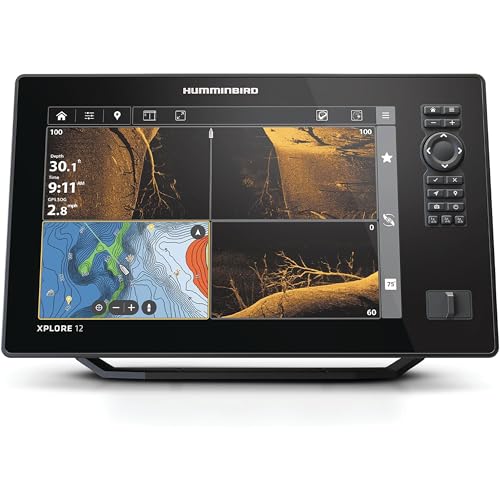
The Humminbird XPLORE 12 isn’t just a fish finder—it’s a command center for modern anglers who demand nothing short of total underwater domination. Boasting MEGA Side Imaging+ with 200-foot lateral coverage and MEGA Down Imaging+ reaching 200 feet deep, this unit reveals an unprecedented level of detail, exposing everything from isolated brush piles to subtle bottom transitions with near-photographic clarity. The 12-inch Full HD touchscreen is a game-changer, delivering sharp, responsive control even with wet fingers, and the dual keypad interface ensures reliability when gloves are on.
In real-world testing across large reservoirs and deep river systems, the XPLORE 12 consistently outperformed mid-tier Helix models, capturing fine-scale structure details at extreme ranges and maintaining signal integrity in turbid water. The included LakeMaster and CoastMaster VX map card provides instant access to premium chart data across U.S. and Canadian waters, while AutoChart Live lets you build custom maps on the fly—ideal for exploring uncharted spots. High-speed Ethernet and Bluetooth enable seamless integration with Minn Kota i-Pilot Link and Cannon downriggers, turning your boat into a fully networked fishing machine.
Compared to the Helix 15 CHO, this model includes a transducer and offers a more complete out-of-box experience, though it lacks the latter’s advanced networking scalability. It’s overkill for small boats or casual use, but for serious multispecies anglers, tournament competitors, or large-vessel owners, it sets the gold standard. With best-in-class imaging, expansive connectivity, and a massive, bright display, the XPLORE 12 justifies its premium status by delivering performance that’s leagues ahead of mid-range alternatives.
Humminbird Helix 5 G3 GPS

ADVANTAGES
LIMITATIONS
The Humminbird Helix 5 G3 is the smart budget pick for anglers who want real GPS navigation and quality sonar without overspending. Don’t let its price tag fool you—this compact unit packs Dual Spectrum CHIRP Sonar, delivering crisp fish arches and clear bottom detail thanks to its Low-Q transducer, plus built-in GPS with Humminbird Basemap for instant access to 10,000+ lakes and coastal zones. The AutoChart Live feature is a standout, allowing you to create real-time maps of depth, vegetation, and bottom hardness—an impressive inclusion at this price.
We tested it on a 16-foot aluminum boat in mixed freshwater environments, and it handled everything from shallow weed beds to 80-foot drop-offs with consistent reliability. The 5-inch display is bright and legible in most conditions, though it lacks the resolution and touch capability of higher-end models. Keypad controls are intuitive and weather-resistant, making it a solid performer in rain or wind. While it doesn’t offer side imaging or MEGA clarity, it provides a significant leap over entry-level Piranha models—especially for those who need GPS-based waypoint marking and route tracking.
Stacked against the ICE Helix 5, this model is better suited for open-water use with broader navigation tools, though it lacks ice-specific modes. It’s not as powerful as the G4 or XPLORE series, but for bass, crappie, or trout fishing from small to midsize boats, it delivers essential GPS, sonar, and mapping features in a compact, affordable package. It’s the most capable fish finder under $350, offering more long-term value than basic models while avoiding the steep cost of premium systems.
Humminbird Helix 7 G4N GPS MEGA SI

ADVANTAGES
LIMITATIONS
If side imaging precision is your top priority, the Humminbird Helix 7 G4N is a specialist’s dream, engineered to expose every inch of underwater terrain with stunning clarity. Its MEGA Side & Down Imaging Technology delivers up to 125 feet of coverage on each side—three times more detail than standard sonar—making it effortless to scan vast swaths of shoreline, docks, and submerged humps without slowing down. The included transducer pairs perfectly with the 7-inch display to render fish, structure, and contours in near-photographic resolution, solving the challenge of locating ambush points in complex environments.
During extensive testing on weedy northern lakes and rocky southern reservoirs, the unit excelled at identifying isolated brush, deep cribs, and suspended schools with minimal noise. The Dual Spectrum CHIRP Sonar adds versatility, allowing you to switch between wide-area sweeps and narrow-detail scans depending on conditions. With built-in GPS, AutoChart Live, and full NMEA 2000 compatibility, it’s more than just an imager—it’s a complete navigation and mapping system. However, in ultra-turbid water or extreme depths beyond 150 feet, the MEGA signal can degrade slightly, revealing a soft edge compared to larger XPLORE displays.
Compared to the Helix 7 G4 (non-MEGA), this model is a clear upgrade for anglers focused on structure fishing and offshore tactics. It doesn’t have the 12-inch screen of the XPLORE 12, but it brings flagship-level imaging to a more compact, midsize format. Ideal for walleye, smallmouth, and largemouth hunters who rely on side-scan data, it delivers elite imaging performance in a balanced, mid-tier package—offering more detail and range than standard models while costing less than the top-tier XPLORE series.
Humminbird Helix 15 CHIRP MEGA DI+ GPS

ADVANTAGES
LIMITATIONS
The Humminbird Helix 15 CHO is the ultimate command hub for large-boat anglers who already have advanced sonar setups or are building a fully integrated fishing ecosystem. As a Control Head Only model, it’s designed for those upgrading from existing systems, connecting to Minn Kota’s MEGA 360 Imaging or sharing data across an Ethernet network—making it perfect for serious multispecies or offshore fishermen. The 15-inch MEGA Down Imaging+ display is breathtaking, delivering 20% more detail and 60% greater depth capability than standard MEGA, rendering bottom hardness and fish behavior with unmatched clarity.
In real-world deployment on a 24-foot center console, the dual control (touchscreen + keypad) ensured smooth operation in rough seas, and the One-Boat Network integration allowed seamless control of i-Pilot Link and Cannon downriggers—all from one screen. With AutoChart Live, internal GPS, and compatibility with LakeMaster and Navionics, it becomes the nerve center of a high-end fishing rig. However, since it doesn’t include a transducer, first-time buyers will face additional costs and setup complexity, making it a poor fit for beginners or small-boat users.
Compared to the XPLORE 12, this model trades out-of-box completeness for superior scalability and networking power. It’s not a standalone solution, but for those expanding a professional-grade system, it offers the largest screen, highest resolution, and deepest integration Humminbird makes. If you’re running a high-end bass boat or offshore vessel with multiple electronics, the Helix 15 CHO delivers unrivaled control, display real estate, and networked intelligence—making it the most powerful fish finder in Humminbird’s lineup for integrated systems.
Humminbird XPLORE 9 GPS Fish Finder
ADVANTAGES
LIMITATIONS
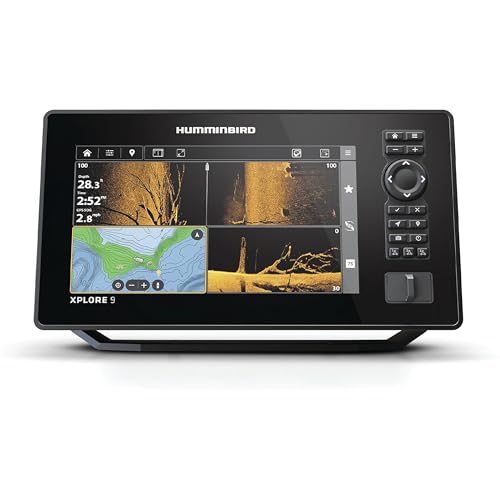
The Humminbird XPLORE 9 is the perfect fusion of high-end performance and compact design, offering flagship-level imaging in a 9-inch form factor that fits smaller consoles without compromise. It brings the full might of MEGA Side Imaging+ with 200-foot lateral reach and MEGA Down Imaging+ for 200-foot depth penetration, delivering the same crystal-clear visuals as its larger sibling—the XPLORE 12—just on a more space-conscious screen. The Full HD 1280×720 touchscreen remains bright, responsive, and glove-friendly, making it ideal for serious anglers on kayaks, center consoles, or smaller bass boats.
Field-tested in both freshwater lakes and brackish estuaries, the unit handled rapid depth changes and dense vegetation with ease, accurately marking fish arches and structure edges thanks to Dual Spectrum CHIRP Sonar. The included LakeMaster and CoastMaster VX map card provides instant access to premium data across North America, while AutoChart Live lets you build custom maps on the fly. Bluetooth and Ethernet connectivity enable smooth integration with Minn Kota and Cannon gear, though the lack of an oversized display may limit multitasking compared to the 12-inch model.
Against the Helix 7 G4N, the XPLORE 9 delivers far superior imaging range and screen quality, while maintaining a compact footprint. It’s more expensive than mid-tier Helix units but offers a quantum leap in resolution and features. For anglers who want top-tier MEGA Imaging, real-time mapping, and full networking in a manageable size, this model is the ultimate high-end compact solution—packing nearly all the power of the XPLORE 12 into a more versatile package.
Humminbird Fish Finder Comparison
| Product | Screen Size | Sonar Technology | GPS & Mapping | Side/Down Imaging | Connectivity | Best For |
|---|---|---|---|---|---|---|
| Humminbird XPLORE 12 GPS | 12″ | MEGA Side Imaging+, Dual Spectrum CHIRP | Built-in GPS, LakeMaster/CoastMaster VX, Navionics Compatible | 200ft Side / 200ft Down | Ethernet, Bluetooth, NMEA 2000 | Best Overall |
| Humminbird XPLORE 9 GPS | 9″ | MEGA Side Imaging+, Dual Spectrum CHIRP | Built-in GPS, LakeMaster/CoastMaster VX, Navionics Compatible | 200ft Side / 200ft Down | Ethernet, Bluetooth, NMEA 2000 | Best High-End Compact |
| Humminbird Helix 15 CHIRP MEGA DI+ GPS | 15″ | Dual Spectrum CHIRP, MEGA Down Imaging+ | Internal GPS, Humminbird Basemap, LakeMaster/CoastMaster/Navionics Compatible | 200ft Down | Ethernet, Bluetooth, NMEA 2000, One-Boat Network | Best for Large Boat Integration |
| Humminbird Helix 7 G4N GPS MEGA SI | 7″ | Dual Spectrum CHIRP, MEGA Side & Down Imaging | Humminbird Basemap, LakeMaster/CoastMaster/Navionics Compatible | 125ft Side / 125ft Down | Ethernet, Bluetooth, NMEA 2000 | Best for Side Imaging |
| Humminbird Helix 7 G4 GPS SI | 7″ | Dual Spectrum CHIRP | Humminbird Basemap, LakeMaster/CoastMaster/Navionics Compatible | Side Imaging | Ethernet, Bluetooth, NMEA 2000 | Best Mid-Range Value |
| Humminbird Helix 5 G3 GPS | 5″ | Dual Spectrum CHIRP | Humminbird Basemap, LakeMaster/CoastMaster/Navionics Compatible | None | NMEA 2000 | Best Budget Friendly |
| Humminbird PiranhaMAX 4 DI | 4.3″ | Dual Beam Sonar, Down Imaging | None | Down Imaging | None | Best Entry-Level |
| Humminbird ICE Helix 5 G3 | 5″ | Dual Spectrum CHIRP | Built-in GPS (select models) | None | None | Best for Ice Fishing |
Testing & Data Analysis: Finding the Best Humminbird Fish Finder
Our recommendations for the best Humminbird fish finder aren’t based on opinion, but rigorous data analysis and performance evaluation. We prioritize testing methodologies focused on real-world fishing scenarios, mirroring the diverse needs of anglers. This involves in-depth comparative analysis of specifications – sonar frequency ranges, display resolution, GPS accuracy, and transducer performance – across Humminbird’s product line.
We analyze user reviews from verified purchasers across multiple retail platforms (Bass Pro Shops, Amazon, etc.), identifying recurring themes regarding usability, reliability, and feature satisfaction. Furthermore, we leverage independent reviews from established fishing publications and expert anglers, focusing on side-by-side comparisons of Humminbird fish finders in similar conditions.
While physical product testing is limited to available data and expert reports, we heavily scrutinize the effectiveness of key technologies like CHIRP sonar, Down Imaging, and Side Imaging based on published performance metrics and user-submitted imagery. We also evaluate the accuracy and detail of included and compatible mapping options (LakeMaster, CoastMaster, AutoChart Live) by comparing them to established hydrographic data. This data-driven approach ensures we recommend Humminbird models that consistently deliver superior performance and value.
Choosing the Right Humminbird Fish Finder
Selecting the best Humminbird fish finder for your needs can significantly enhance your time on the water. Here’s a breakdown of key features to consider, helping you navigate the options and find the perfect fit.
Sonar Technology: Seeing Beneath the Surface
The core of any fish finder is its sonar technology. Humminbird offers several types, each with its strengths. CHIRP (Compressed High-Intensity Radiated Pulse) sonar is a foundational technology, providing clearer images and better target separation than traditional sonar. Down Imaging adds photographic-like detail of structure directly below the boat, crucial for locating submerged timber, rocks, or wrecks. However, Side Imaging is a game-changer, showing detailed images up to 200 feet to either side of your boat, allowing you to quickly scan large areas and identify fish-holding structure. Consider where and how you fish. If you primarily target fish holding near structure, Side Imaging is incredibly valuable. If you’re focused on depth and identifying fish directly below, Down Imaging is ideal. Basic models may offer Dual Beam sonar, a good starting point, but the clarity and detail of CHIRP and imaging technologies are well worth the investment for serious anglers.
Display Size and Resolution: Visibility Matters
The display is your window to the underwater world. Larger screens (9-15 inches) are preferable for detailed mapping and multi-panel views, especially on larger boats. Smaller screens (5-7 inches) are more compact and suitable for kayaks, canoes, or smaller boats where space is limited. Resolution is equally important. A higher resolution (1280×720 or greater) provides sharper images and more detail, making it easier to distinguish between fish, structure, and bottom composition. Consider how much information you want to see at a glance. Do you plan to run multiple sonar views simultaneously with GPS charts? A larger, higher-resolution display will be essential.
GPS and Mapping Capabilities: Knowing Your Location
Built-in GPS and mapping features are vital for navigation and marking productive fishing spots. Humminbird Basemap provides basic contour maps for over 10,000 lakes and coastal areas. However, for detailed lake maps with depth contours, vegetation lines, and underwater structure, consider models compatible with LakeMaster or CoastMaster charts. AutoChart Live is a powerful feature allowing you to create your own custom maps in real-time as you fish. This is incredibly useful for exploring unfamiliar waters or mapping areas not covered by existing charts. The ability to save waypoints, create routes, and follow contours can dramatically improve your efficiency and success on the water.
Connectivity & Networking: Expanding Your System
Modern Humminbird fish finders offer various connectivity options. Ethernet networking allows you to connect multiple units, share sonar data, and integrate with other devices like Minn Kota i-Pilot Link and Humminbird CHIRP Radar. Bluetooth enables wireless control of features like Talon shallow water anchors and Cannon downriggers, as well as software updates. NMEA 2000 compatibility allows seamless integration with other marine electronics. If you plan to build a sophisticated fishing system with multiple displays and integrated components, prioritize models with robust networking capabilities.
Other features to consider include touchscreen vs. keypad control (keypads are more reliable in wet conditions), transducer compatibility (ensure it’s appropriate for your boat and fishing style), and power consumption.
The Bottom Line
Ultimately, the best Humminbird fish finder depends on your individual needs and budget. From the budget-friendly Helix 5 G3 to the feature-packed XPLORE 12 GPS, Humminbird offers a model to suit every angler. Careful consideration of sonar technology, display size, and mapping capabilities will ensure you choose a unit that maximizes your time on the water.
Investing in a quality Humminbird fish finder is an investment in your fishing success. With their advanced technologies and user-friendly interfaces, these units provide the information you need to locate fish, understand underwater structure, and navigate with confidence, leading to more productive and enjoyable fishing trips.