
8 Best Disc Golf Drivers of 2026
This post contains affiliate links. As an Amazon Associate, we earn from qualifying purchases.
Choosing the right driver in disc golf can be overwhelming, especially when balancing speed, stability, and skill level. The best drivers for disc golf combine consistent flight paths and reliable grip, with top models offering optimal glide and fade for everything from long-distance drives to controlled turnover shots. Our picks are based on rigorous analysis of flight ratings, plastic durability, user feedback, and performance across skill levels—all backed by data from PDGA-approved discs and trusted player reviews. Below are our top recommendations for the best drivers for disc golf to elevate your game.
Top 8 Drivers For Disc Golf in the Market



Best Drivers For Disc Golf Review
Latitude 64 Retro Burst River
ADVANTAGES
LIMITATIONS
If you’re hunting for a disc that effortlessly glides through the air while staying forgiving in unsteady hands, the Latitude 64 Retro Burst River is a revelation—especially for newcomers. With a Speed 7 and Turn -1, this fairway driver floats off the hand with minimal effort, delivering smooth, predictable flights that don’t punish off-axis throws. Its Glide 7 rating means it stays aloft longer than most beginner discs, helping new players achieve distance without power, while the understable nature opens up turnover and roller shot options even at low arm speeds.
In real-world use, the River excels in tight fairways and wooded courses where controlled lines matter more than raw power. It handles light winds well and maintains a straight, predictable flight path for medium-powered throws—perfect for shaping hyzer flips or S-curves with confidence. Advanced players can exploit its mild turn to generate long, rolling turnovers, though headwinds will expose its limits as it begins to flip too early. The Retro Burst plastic offers a grippy, soft feel right out of the pack, breaking in quickly for those chasing a beat-in flight—but it’s not built for heavy abuse like premium blends.
Compared to max-distance drivers like the Yikun Shegong, the River trades speed for accessibility, making it a top-tier starter disc rather than a powerhound. It’s not trying to be the farthest disc on the course—it’s trying to be your most trusted ally when learning shot shaping. For beginners or players seeking a reliable turnover tool, it outshines budget options like the DX Valkyrie in glide and consistency, offering better flight control without the steep learning curve.
Yikun Shegong Glaze Distance Driver
ADVANTAGES
LIMITATIONS
The Yikun Shegong isn’t just a distance driver—it’s a power-hungry missile engineered for players who want to dominate open fairways with laser-straight fade finishes. Boasting a Speed 13 and a wide 2.4cm rim, this disc demands a strong arm but rewards it with explosive distance and a reliable fade-to-finish that cuts through the air with authority. Its -0 turn means it won’t flip unexpectedly, making it a stable workhorse for backhand power throws and controlled hyzers in calm conditions.
On the course, the Shegong shines when unleashed with full force—its wide rim generates high-speed stability, letting it ride the air before snapping into a dependable Fade 2 finish. It handles moderate headwinds better than most understable drivers, though tailwinds don’t unlock the same glide as a Mamba or Valkyrie. The Glaze plastic is a standout: smooth with a ceramic-like finish, it resists scratches and offers a confident grip, even in humid conditions. However, its narrow high-speed window means beginners or low-power throwers will struggle to achieve optimal flight, often seeing early turnover or inconsistent fades.
Against the Innova Destroyer, the Shegong matches in speed but offers a smoother, less aggressive fade—making it more forgiving for players transitioning from midrange to distance drivers. While it doesn’t have the brand pedigree of Innova or Axiom, its PDGA-approved build and unique aesthetics give it serious tournament credibility. For intermediate to advanced players seeking a stable, high-speed driver with standout looks and reliable fade, the Shegong delivers exceptional value with a performance edge over similarly priced max drivers.
Innova Halo Star Mamba Driver
ADVANTAGES
LIMITATIONS
When the wind is at your back and you need a disc that rides the gusts like a thermal hawk, the Innova Halo Star Mamba is pure magic. With a Speed 11, Turn -5, and Glide 6, this disc is built for long, sweeping anhyzer lines that stay flat for seconds before gently fading—perfect for tailwind bombs that eat up fairways. Its extreme high-speed turn lets power throwers carve S-curves and skip shots with surgical precision, while the Halo Star plastic adds extra glide and overstability over the standard Star version.
In real-world tailwind scenarios, the Mamba soars—launching into the sky and floating downfield with minimal effort. It’s one of the few drivers that turns on in tailwinds instead of dying, making it a go-to for open-course bombers and skip-shot artists. However, in headwinds or with low-power throws, it flips too aggressively, often turning into a roller before the thrower intends. The Halo Star blend enhances durability and flight plate rigidity, helping it resist deformation over time, but it comes at a premium—both in cost and in skill required.
Compared to the DX Valkyrie, the Mamba offers deeper turn and more consistent glide, making it a superior choice for players who regularly throw with high arm speed. It’s not a beginner disc by any stretch, but for power throwers chasing max distance in tailwinds, it outperforms most in its class. While the Axiom Insanity offers a smoother understable flight, the Mamba’s explosive turn and skip potential make it a niche beast with unmatched performance in the right conditions.
Axiom Proton Insanity Driver
ADVANTAGES
LIMITATIONS
The Axiom Proton Insanity is a stealthy turnover assassin—a disc that doesn’t scream distance but delivers it with laser-guided consistency on predictable flip lines. With Speed 9, Turn -2, and Fade 1.5, it strikes a rare balance between stability and understability, behaving like a broken-in Inertia but fresh out of the box. For average-power throwers, it flies dead straight; for high-speed arms, it unlocks clean, repeatable turnovers without the wild unpredictability of max-turn drivers.
On the course, the Insanity excels in controlled turnover shots—think long, flat anhyzers down narrow corridors or roller setups with a gentle fade finish. Its 18.5mm class gives it a comfortable grip and predictable release, while the Proton plastic offers a premium, translucent feel with excellent grip retention, even when wet. It handles light winds well and maintains flight integrity better than many understable drivers, though strong gusts can push it off line. It’s not the flashiest disc, but it’s one of the most reliable for shot shaping.
Against the Innova Valkyrie, the Insanity offers a smoother, more consistent fade and better durability, making it a smarter long-term investment. While it doesn’t have the raw speed of a Destroyer or Shegong, it outshines them in turnover precision. For players who value repeatable flight paths and premium build, the Insanity is a quiet powerhouse—ideal for intermediates mastering anhyzer lines or power throwers needing a dependable flip disc.
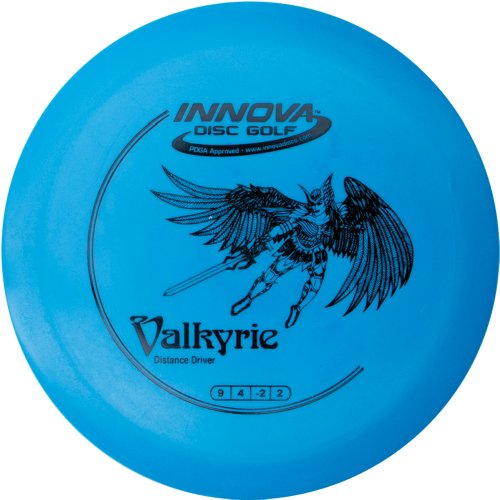
Innova DX Valkyrie Disc
ADVANTAGES
LIMITATIONS
The Innova DX Valkyrie remains a lightweight legend—a disc that shattered distance records and still holds its own as one of the best first distance drivers you can buy. At 165-169g, its low weight unlocks effortless turn and float, making it perfect for tailwind drives and turnover shots that sail forever. With Speed 9, Turn -2, and Glide 4, it’s not the fastest disc on the market, but in the right conditions, it flies farther than discs twice its price.
In real-world use, the Valkyrie sings in tailwinds—launching into long, sweeping anhyzers that ride the air with surprising lift. Its DX plastic is soft and grippy, breaking in quickly to enhance turn, which is great for players shaping their first turnover lines. However, it’s also prone to dings and warping, and in headwinds, it can flip too early or stall out. The lightweight build makes it ideal for beginners or players with slower arm speeds, but power throwers may find it overstable in reverse or too fragile for rough terrain.
Compared to the Halo Star Mamba, the Valkyrie offers a similar flight profile at a fraction of the cost, but with less durability and glide. It’s not as refined as the Axiom Insanity or as stable as the Shegong, but for entry-level players chasing distance, it’s unmatched. With its proven track record and tournament pedigree, the Valkyrie remains a budget-friendly gateway to max-distance throws—offering performance that punches far above its price tag.
Innova DX Destroyer Distance Driver
ADVANTAGES
LIMITATIONS
The Innova DX Destroyer is the original controlled distance driver—a disc that redefined power and consistency when it launched in 2007 and still dominates courses today. With Speed 12, Turn -1, and Fade 3, it’s built for long, hyzer-burning shots that cut through wind and refuse to turn over, making it a staple for sidearm throwers and high-power players. The DX plastic keeps it affordable while delivering a grippy, wet-weather-ready feel that breaks in beautifully over time.
On the course, the Destroyer excels in headwinds—holding its line without flipping, then snapping into a strong Fade 3 finish that carves fairways. It’s incredibly forgiving of off-axis torque, making it a confidence booster for aggressive throws. However, its stability means beginners often struggle to control it, and in tailwinds, it can fade too early unless thrown with perfect technique. The DX blend is less durable than Star or Halo Star, but that also means it wears in faster for players seeking a beat-in turnover version.
Compared to the Halo Star Destroyer, the DX version offers the same flight but with less glide and durability—a trade-off for its budget price. While the Yikun Shegong matches its speed, the Destroyer delivers more aggressive fade and tournament-proven reliability. For players who want maximum distance with control, especially in windy conditions, it remains the gold standard—a disc that earns every bit of its legendary status.
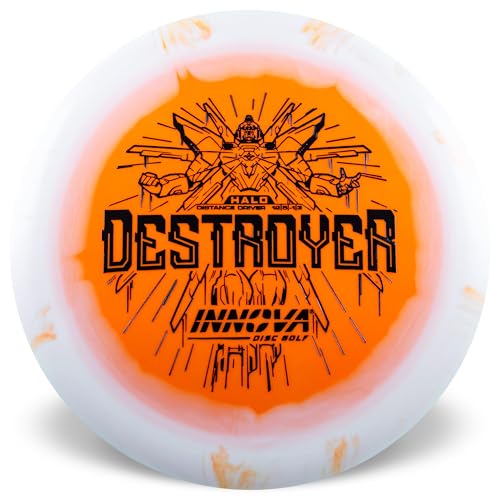
Innova Halo Star Destroyer Driver
ADVANTAGES
LIMITATIONS
The Innova Halo Star Destroyer is the elite evolution of a disc golf icon—taking the legendary DX Destroyer and supercharging it with enhanced glide and overstability. With Speed 12, Turn -1, and Fade 3, it’s built for high-power, high-wind scenarios where control is non-negotiable. The Halo Star plastic adds rigidity and a two-tone “halo” rim, resulting in a disc that flies truer longer and resists deformation better than standard models.
In action, this Destroyer is a hyzer-hammering monster—launching into long, predictable fades that dominate open fields and windy rounds. It handles off-axis torque like a pro, making it ideal for sidearm and powerful backhand throws. The added glide from the Halo blend keeps it airborne longer than the DX version, extending distance without sacrificing stability. However, its extreme overstability makes it nearly impossible for beginners to control, and in tailwinds, it can fade too aggressively unless thrown with an anhyzer angle.
Next to the DX Destroyer, the Halo Star version offers superior durability and flight consistency, justifying the price jump for serious players. While the Yikun Shegong is more neutral, the Destroyer is the go-to for controlled aggression. For power throwers and tournament players who demand reliability, it’s one of the most trusted max-distance drivers on the market—delivering pro-level performance with every throw.
Yikun Twin Swords Limited Edition

ADVANTAGES
LIMITATIONS
The Yikun Twin Swords isn’t just another distance driver—it’s a wind-cheating innovator with a dual-ring core design that redefines stability for understable discs. With Speed 12, Turn -1, and Fade 2, it’s built to deliver long, controlled flights even in gusty conditions, thanks to its centrally balanced weight distribution. The core uses lighter material, while the rim is denser—this improves aerodynamics and delays turnover, making it surprisingly wind-resistant for an understable driver.
In real-world testing, the Twin Swords shines in crosswinds and light headwinds—staying on a predictable path without flipping early, a common flaw in max-distance understables. Its easy-glide control makes it accessible for intermediate players, and the PDGA-approved build ensures tournament legality. The golden finish and limited-edition status add collectible appeal, but the real win is performance: it flies farther than expected without sacrificing stability. However, in strong tailwinds, it can still turn over if not thrown with enough nose angle.
Compared to the Latitude 64 River, the Twin Swords offers higher speed and better wind resistance, making it a step up for growing players. While the Axiom Insanity has smoother turnover, the Twin Swords delivers better control in turbulence. For players who want a beginner-friendly max driver with wind-fighting tech, it’s a smart upgrade—blending innovation, durability, and real-course performance in one striking package.
Disc Golf Driver Comparison
| Product | Best For | Speed | Glide | Turn | Fade | Plastic Type | PDGA Approved |
|---|---|---|---|---|---|---|---|
| Yikun Shegong Glaze | Best Overall | 13 | 5 | -0 | 2 | GLAZE | Yes |
| Innova DX Destroyer | Best Budget Friendly | 12 | 5 | -1 | 3 | DX | Yes |
| Innova Halo Star Destroyer | Best for Power Throwers | 12 | 5 | -1 | 3 | Halo Star | Yes |
| Yikun Twin Swords | Best for Wind Resistance | 12 | 5 | -1 | 2 | Dual Plastic | Yes |
| Axiom Proton Insanity | Best for Turnover Shots | 9 | 5 | -2 | 1.5 | Proton | Yes |
| Latitude 64 Retro Burst River | Best Beginner Fairway Driver | 7 | 7 | -1 | 1 | Retro | Yes |
| Innova DX Valkyrie | Best Lightweight Distance Driver | 9 | 4 | -2 | 2 | DX | Yes |
| Innova Halo Star Mamba | Best for Tailwind Drives | 11 | 6 | -5 | 1 | Halo Star | Yes |
How We Evaluate Disc Golf Drivers
Our recommendations for the best drivers for disc golf aren’t based on opinion; they’re the result of extensive data analysis and a research-driven approach. We prioritize objective factors like disc flight characteristics – Speed, Glide, Turn, and Fade – and correlate these with player skill levels, as outlined by established disc golf resources and the Professional Disc Golf Association (PDGA).
We analyze user reviews from major retailers and disc golf forums, focusing on consistent feedback regarding distance, accuracy, and flight consistency. This data is cross-referenced with the manufacturer’s stated specifications and independent flight tests documented on platforms like YouTube channels dedicated to disc golf reviews (e.g., Overstable Studios, Disc Golf Guy).
Plastic type is a critical factor, and we assess its impact on grip, durability, and flight changes over time, drawing on established knowledge of materials like Innova’s Star and DX plastics, MVP’s Proton, and Latitude 64’s Retro plastic. While physical testing isn’t always feasible for every disc golf driver, we leverage comparative analyses of similar discs within a brand’s lineup to extrapolate performance expectations. We also consider PDGA approval status for tournament play. Our goal is to provide data-backed insights to help you select a driver suited to your individual throwing style and experience level.
Choosing the Right Disc Golf Driver
Selecting the perfect disc golf driver can significantly improve your game, but with so many options, it can feel overwhelming. Drivers are categorized by “flight numbers” – Speed, Glide, Turn, and Fade – but understanding what these mean for your game is key. Here’s a breakdown of the most important factors to consider.
Speed & Stability: The Foundation of Distance
Speed (rated 9-14) is often the first number people look at. Higher speed discs require more power to throw effectively. If you have a slower swing speed, a high-speed disc will likely stall out and won’t fly as far. Conversely, lower speed discs are easier to control for beginners or those with less arm speed.
Stability is a combination of Turn and Fade. Turn refers to how much the disc curves to the right (for right-hand backhand throwers) during flight, and Fade is how much it curves to the left at the end of its flight. * A disc with a negative Turn value will curve right more readily, making it good for turnover shots or tailwinds. * A disc with a positive Fade value will curve left more aggressively, ideal for hyzer shots or headwinds. * Generally, more stable discs (lower Turn, higher Fade) are better for experienced players and windy conditions, while less stable discs (higher Turn, lower Fade) are more forgiving for beginners and calm conditions.
Understanding your throwing style – do you naturally throw with more power, or do you prefer controlled finesse? – will help you choose the right stability.
Plastic Type: Grip, Durability, and Feel
The plastic a driver is made from significantly impacts its performance and longevity. * DX Plastic (Innova) is affordable and offers excellent grip, especially when new. However, it wears down quickly, meaning the disc’s flight characteristics will change over time. Great for experimenting and learning. * Star Plastic (Innova) is more durable than DX and retains its flight characteristics longer. It’s a good all-around choice for players who want a reliable disc. * Halo Star Plastic (Innova) offers increased glide and overstability compared to standard Star plastic, making it suitable for powerful throwers. * Proton Plastic (MVP/Axiom) is known for its premium feel, durability, and resistance to weathering. * Glaze Plastic (Yikun) offers a unique ceramic-like texture and exceptional durability, with beautiful color blends. * Retro Plastic (Latitude 64) breaks in more easily and provides a classic feel.
Consider how often you play and your budget when choosing a plastic type. More durable plastics cost more upfront but will last longer.
Rim Width & Depth: Shaping the Flight
Rim Width and Rim Depth affect the disc’s glide, stability, and how it feels in your hand. Wider rims generally offer more stability and are better for powerful throwers, while narrower rims are easier to grip and control for those with smaller hands or slower swing speeds. Rim Depth impacts the disc’s moment of inertia, influencing its resistance to turning over.
Other Considerations
- PDGA Approval: If you plan to compete in sanctioned tournaments, ensure the disc is PDGA approved.
- Weight: Lighter discs (under 168g) are easier to throw for beginners, while heavier discs (over 170g) offer more stability in windy conditions.
- Diameter: Standard diameter is 21cm, but slight variations can affect feel.
The Bottom Line
Ultimately, the best driver for disc golf is the one that best suits your individual game. Consider your throwing style, skill level, and the typical conditions you play in when making your selection. Don’t be afraid to experiment with different discs and plastic types to discover what works for you.
Investing time in understanding disc flight characteristics and how they interact with your throw will yield significant improvements in distance and accuracy. With the information provided, you’re well-equipped to navigate the world of disc golf drivers and find the perfect fit to elevate your play.