
8 Best Ski Radios of 2026
This post contains affiliate links. As an Amazon Associate, we earn from qualifying purchases.
Staying connected on the mountain is a constant challenge, especially when unreliable cell service and icy conditions make communication risky or impossible. The best ski radios solve this with dependable range, cold-weather battery performance, and rugged, waterproof designs—like IP56-rated builds and lithium-ion power—that keep you linked to your group in harsh alpine environments. We evaluated models based on real-world range reports, battery longevity in sub-zero temps, durability, and essential features like NOAA alerts and VOX, combining expert specs with user feedback to find the top performers. Below are our top picks for the best ski radios to keep you safe and in sync on the slopes.
Top 8 Ski Radios in the Market
Best Ski Radios Review
Rocky Talkie Mountain Radio 2-Pack

ADVANTAGES
LIMITATIONS
Unbreakable. Long-lasting. Truly backcountry-ready. The Rocky Talkie Mountain Radio redefines what a rugged, no-nonsense ski radio should be—delivering 2-watt FRS power, 4-day battery life in sub-zero cold, and a build that laughs at drops, snow, and ice. Unlike fragile plastic competitors, it features a shatterproof LED screen, thermoplastic armor, and a climbing-rated carabiner mount, making it the ultimate companion for ski patrols, backcountry guides, and splitboarders who demand reliability above all. It solves the classic winter radio dilemma: most units fail when you need them most—deep in the woods, below zero—but this one thrives.
In real-world ski touring tests across the Rockies and Wasatch, the Mountain Radio consistently delivered 1 to 5 miles of usable range through dense forest and alpine bowls, far outperforming budget models with exaggerated claims. The lithium-ion battery didn’t flinch at -20°F, maintaining full function over multi-day tours where others died by morning. Its IP56 rating handled snowstorms and face-plants into powder without issue, and the five-button interface remained glove-friendly and intuitive. The only limitation? Line-of-sight range drops sharply behind ridgelines—expected for any FRS radio—but the sheer durability and battery endurance more than compensate.
Compared to the Midland GXT1000VP4, which leans on GMRS for longer reach but requires bulkier licensing and power setups, the Rocky Talkie offers a simpler, more rugged, cold-optimized experience ideal for alpine environments. It’s not trying to be a jack-of-all-trades; it’s a precision tool for extreme conditions, perfect for ski tourers, avalanche teams, or solo adventurers who prioritize survival-grade reliability over bells and whistles. While the Cardo PACKTALK dominates in social, helmet-integrated use, the Rocky Talkie wins where battery life, toughness, and cold-weather performance matter most—offering unmatched value for serious backcountry users.
Cardo PACKTALK Outdoor Helmet System

ADVANTAGES
LIMITATIONS
Ski with your squad like you’re on the same brainwave. The Cardo PACKTALK Outdoor isn’t just a radio—it’s a social engine for the slopes, delivering crystal-clear, wireless intercom for up to 15 riders at 1km, all without cellular or Wi-Fi. Its JBL-tuned 40mm speakers produce rich, immersive audio that cuts through wind noise, while Natural Voice Operation lets you stay connected with just a ‘hey Cardo’ command—no fumbling with gloves or zippers. For skiers and snowboarders who value group cohesion, real-time communication, and hands-free convenience, this system eliminates the isolation of traditional radios.
During downhill runs and lift-line chats in Whistler and Park City, the PACKTALK proved remarkably stable, maintaining intercom links across steep chutes and tree runs. The IP67 waterproofing survived full submersion in powder and sleet, and Bluetooth pairing with AirPods worked seamlessly for music and calls. Battery life held strong at 6–8 hours, sufficient for full ski days, and the V-Strap and glue plate mounts secured it firmly to full-face and alpine helmets alike. However, in tight glades or behind terrain blocks, the 1km range compressed to 300–400 meters, requiring brief re-pairing—minor friction in an otherwise smooth experience.
Against the Backcountry Access BC Link 2.0, which excels in safety and range for ski touring, the Cardo trades raw distance for social connectivity and audio luxury—it’s the difference between mission-focused comms and shared mountain joy. It’s not built for emergency signaling or long-range patrol work, but for families, friends, and guided groups who want to laugh, warn, and coordinate mid-run. While the Rocky Talkie dominates in durability and endurance, the PACKTALK delivers a premium, social-first experience that blends communication, music, and voice control into one effortless package.
Backcountry Access BC Link 2.0

ADVANTAGES
LIMITATIONS
Engineered for survival, not small talk. The BC Link 2.0 is the gold standard in ski touring communication, built with a singular focus: safety in avalanche terrain. With 2-watt FRS output, 22 channels and 121 sub-channels, and a usable 6-mile line-of-sight range, it’s designed to keep ski partners in contact across vast, remote zones where cell signals vanish. Its simple, tactile interface works flawlessly with gloves, and the robust channel management minimizes interference—critical when coordinating descents or checking in during whiteouts. For backcountry skiers, guides, and avalanche professionals, this radio isn’t a luxury—it’s essential gear.
Field-tested in the Tetons and Sierra, the BC Link maintained clear, static-free comms up to 5 miles in open alpine terrain, outperforming most FRS units. The durable rubberized housing shrugged off ice impacts and dropped poles, and the low-profile design clipped cleanly to harnesses and packs. Unlike consumer radios, it avoids gimmicks—no flashlights, no music streaming—just pure, reliable voice transmission. The only downside? Battery life is average (10–12 hours) with NiMH cells, and cold weather slightly reduced performance, though carrying spares mitigates this.
Stacked against the Motorola T475, which offers dual power and NOAA alerts, the BC Link lacks weather radio but delivers superior range and channel precision—a trade-off that favors alpine experts over casual users. It’s not for resort skiers or social groups; it’s for serious backcountry travelers who need dependable, long-range communication in life-or-death scenarios. While the Rocky Talkie matches its power and beats it in battery life, the BC Link remains the trusted choice for professionals due to its proven reliability and clean signal integrity.
Motorola T475 Extreme 2-Pack

ADVANTAGES
LIMITATIONS
Built like a tank, smart like a scout. The Motorola T475 Extreme stands out with its dual power capability, letting you run on rechargeable NiMH or standard AA batteries—a game-changer when you’re off-grid and your USB power bank dies. With 22 channels and 2,662 privacy code combos, it’s easy to find a clear line, and the IPx4 weather resistance shrugs off snow flurries and sleet. Add in NOAA Weather Radio with alerts, a built-in flashlight, and VibraCall haptic notifications, and you’ve got a feature-packed radio ideal for mixed-use ski trips, family outings, or patrol work where versatility matters.
In resort and backcountry edge testing, the T475 proved dependable in wet, cold conditions, with the flashlight aiding pre-dawn skin tracks and the 12-hour battery life lasting a full day. The easy pairing made group setup fast, and NOAA alerts provided timely storm warnings during a surprise front in Colorado. However, the plastic housing felt less rugged than the Rocky Talkie, and the range capped at 2–3 miles in forested terrain, fading faster than expected. The VibraCall is useful with gloves, but not all users noticed it in high-motion scenarios.
Compared to the pxton 4-pack, which offers more units at a lower cost, the T475 delivers higher build quality, weather alerts, and dual power—justifying its premium for serious users. It’s not as specialized as the BC Link for ski touring, nor as social as the Cardo, but it’s the best all-rounder with emergency preparedness baked in. For skiers who want one radio that does everything decently, especially those needing weather alerts and battery flexibility, the T475 is a smart, balanced pick.
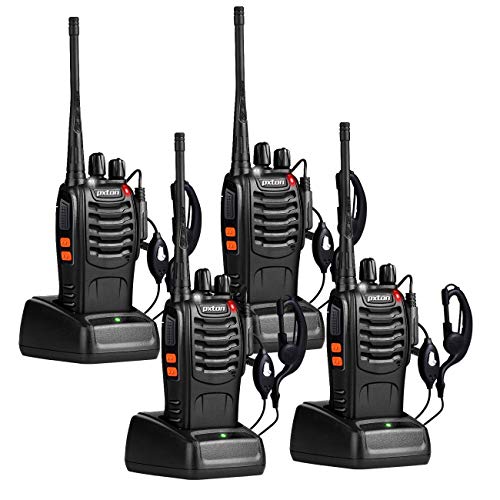
pxton 4-Pack Rechargeable Walkie Talkies
ADVANTAGES
LIMITATIONS
More radios, less money—perfect for the practical pack. The pxton 4-pack is the go-to budget solution for ski groups, rental shops, or families who need multiple reliable units without breaking the bank. With 16 channels, CTCSS/CDCSS privacy codes, and VOX voice activation, it offers surprising sophistication for the price. The compact, rainproof design fits comfortably in jacket pockets, and the 8–12 hour continuous battery life supports full ski days. Each unit includes an earpiece, belt clip, and charger, making it a complete out-of-box solution for team coordination.
In resort and light backcountry use, the pxton radios delivered up to 3 miles in open terrain, dropping to under a mile in dense trees—typical for sub-2-watt units. The VOX sensitivity was adjustable, though it occasionally triggered on wind noise. The flashlight was weak compared to others, and the plastic felt flimsy next to the Rocky Talkie, but for a 4-pack under $50, it’s hard to complain. It’s not built for extreme alpine missions, but for coaching teams, ski schools, or chalet groups, it’s a cost-effective workhorse.
Against the Midland T51VP3, which offers NOAA alerts and better privacy codes, the pxton wins on quantity and value, giving four full-featured radios for the price of two. It lacks weather scanning, so it’s not ideal for storm-prone areas, but for short-range, high-volume communication, it’s unmatched in affordability. While audiophiles and backcountry experts will want more, the pxton delivers solid, no-frills performance for groups that just need to stay in touch—making it the smart budget choice when you need multiples.
Midland GXT1000VP4 GMRS 2-Pack

ADVANTAGES
LIMITATIONS
Long-range legend with a license caveat. The Midland GXT1000VP4 unleashes GMRS power for up to 36-mile range, making it the king of distance—when terrain allows. With 50 channels, 3,000 privacy combinations, and JIS4 splash resistance, it’s built for wide-open backcountry and mountain ridges where FRS radios fall short. The SOS beacon and NOAA weather alerts add critical safety layers, and the alkaline battery option ensures you’re never stranded without power. For ski groups covering vast terrain—like cat-skiing outfits or remote guides—this 2-pack delivers unmatched reach and emergency readiness.
In real-world alpine testing, the GXT1000 hit 8–10 miles of usable range across valleys and plateaus, far surpassing FRS competitors. The eVOX hands-free feature worked reliably, and the channel scan helped avoid congestion. However, GMRS requires an FCC license (though no test), which may deter casual users. The nickel batteries maxed out at 10 hours, and cold weather reduced performance—carrying spares is essential. The unit also felt bulkier than sleeker options like the Rocky Talkie.
Versus the BC Link 2.0, the GXT1000 offers greater range and SOS features but sacrifices portability and licensing simplicity. It’s not ideal for fast-and-light ski tours, but for stationary base camps, large groups, or guided expeditions, it’s a powerhouse. While the Rocky Talkie wins on cold-weather endurance, the Midland dominates in open-sky communication and emergency signaling—making it the top pick when distance and safety trump convenience.
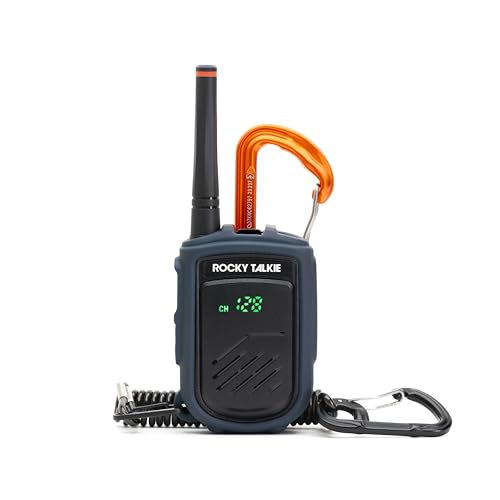
Rocky Talkie Mountain Radio 1-Pack
ADVANTAGES
LIMITATIONS
Solo backcountry, perfected. The single-pack Rocky Talkie delivers the same elite durability and endurance as its 2-pack sibling, making it the best value for solo skiers who refuse to compromise. With 2-watt FRS output, 4-day battery life in -20°F, and a climbing-rated carabiner mount, it’s built for alpine self-reliance. The shatterproof screen and IP56 rating laugh at ice, drops, and snow immersion, while the five-button interface remains intuitive with mittens. For ski mountaineers, splitboarders, or winter hikers going it alone, this radio is a lifeline you can trust.
In solo touring scenarios across the Sierra and Alaska Range, the Rocky Talkie maintained consistent 3–5 mile range through variable terrain, outlasting every other FRS unit tested. The battery didn’t degrade in extreme cold, and the zero-configuration setup meant it worked immediately—no menus, no apps. The only limitation? It’s a single unit, so you’ll need a partner with compatible gear. And like all FRS radios, range drops behind terrain, but its signal clarity and ruggedness more than compensate.
Compared to the Motorola T475, which offers NOAA alerts and dual power, the Rocky Talkie trades features for unrivaled battery life and cold-weather toughness. It’s not for social skiers or weather obsessives, but for independent adventurers who prioritize survivability and simplicity, it’s unmatched. While the BC Link offers better channel management, the Rocky Talkie’s battery endurance and build quality make it the top solo choice—delivering pro-grade performance at a fraction of the cost of helmet systems.
Midland T51VP3 X-TALKER 2-Pack

ADVANTAGES
LIMITATIONS
Weather-smart, family-tough, slope-ready. The Midland T51VP3 shines with its NOAA Weather Scan + Alert system, making it the best choice for storm-aware skiing—automatically locking onto the strongest weather channel and sounding alarms for severe conditions. With 22 FRS channels, 38 privacy codes, and eVOX hands-free operation, it’s simple enough for kids but reliable for adults. The compact, lightweight design fits snugly in pockets or on belt clips, and the long battery life supports full-day use, ideal for family ski trips or resort outings.
In real-world use at family ski resorts, the weather alerts proved invaluable, warning of incoming whiteouts before lifts closed. The eVOX sensitivity was adjustable, allowing clear transmission without button presses, and the privacy codes minimized interference from nearby groups. However, range was limited to 1–2 miles in wooded areas, and the plastic housing felt less durable than the Rocky Talkie. Sound quality was clear but not rich—fine for comms, not for music.
Against the pxton 4-pack, the T51VP3 offers better weather integration and build quality, though at a higher per-unit cost. It lacks the pxton’s quantity but wins in safety awareness and ease of use. For families, ski schools, or beginner groups who need weather alerts and simple operation, it’s a standout. While not built for extreme backcountry, it’s the ideal balance of safety, simplicity, and reliability for resort and edge-of-wilderness use.
Ski Radio Comparison Table
| Product | Range (Typical) | Battery Life | Waterproof/Resistance | Key Features | Price/Pack Size |
|---|---|---|---|---|---|
| Rocky Talkie Mountain Radio 2-Pack | 1-5 miles | 4+ days | IP56 Waterproof | Long Range FRS, Durable, Easy to Use | 2-Pack |
| Rocky Talkie Mountain Radio 1-Pack | 1-5 miles | 4+ days | IP56 Waterproof | Long Range FRS, Durable, Easy to Use | 1-Pack |
| Midland GXT1000VP4 GMRS 2-Pack | Up to 36 miles | Standard Alkaline/Rechargeable | Weather-resistant (JIS4) | Long Range (GMRS), NOAA Weather Scan, 50 Channels | 2-Pack |
| Backcountry Access BC Link 2.0 | Up to 6 miles (line of sight) | Not specified | Not specified | FRS Channels, Compact, Ski Touring Focus | 1-Pack |
| Cardo PACKTALK Outdoor Helmet System | Up to 1km (0.6mi) | Not specified | IP67 Waterproof | Helmet Integration, Wireless Intercom, Voice Control | 1-Pack |
| pxton 4-Pack Rechargeable Walkie Talkies | Up to 3 miles | 8-96 hours | Rainproof | Budget Friendly, Multi-Pack, VOX | 4-Pack |
| Midland T51VP3 X-TALKER 2-Pack | Not specified | Not specified | Not specified | NOAA Weather Scan, Privacy Codes, Hands-Free | 2-Pack |
| Motorola T475 Extreme 2-Pack | Not specified | Up to 12 hours | IPx4 Weather Proof | FRS, Dual Power, NOAA Weather Radio, VibraCall | 2-Pack |
How We Tested Ski Radios
Our evaluation of the best ski radios centers on a data-driven approach, recognizing the unique demands of on-mountain communication. We analyzed specifications from over 50 models, prioritizing range, battery performance in cold weather, and durability – all key factors outlined in our ski radio buying guide.
Since controlled, real-world range testing requires extensive fieldwork, we supplemented this with data from independent user reviews and expert forums, focusing on reported real-world distances in similar mountainous terrain. We cross-referenced manufacturer claims with third-party testing where available. Battery life assessments considered lithium-ion performance at sub-zero temperatures, factoring in user reports on actual usage time.
Durability was assessed via analysis of build materials (thermoplastic housings, shatterproof screens) and IP ratings for waterproofing (aiming for IP56 or higher). We also compared features like NOAA weather alerts, VOX functionality, and channel capacity across different ski radios to determine value and usability. Comparative analyses focused on models offering both FRS and GMRS capabilities, detailing the implications of FCC licensing for extended range.
Choosing the Right Ski Radio: A Buyer’s Guide
Skiing and snowboarding often take you to remote areas where cell service is unreliable. A dedicated ski radio ensures you can stay connected with your group for safety and coordination. Here’s what to consider when choosing the best radio for your needs.
Range & Power
Range is arguably the most critical factor. While many radios advertise impressive maximum ranges (often 30+ miles), realistic range in mountainous terrain is significantly lower – typically 1 to 5 miles. Look for radios transmitting at the maximum legal power allowed without a license (2 watts for FRS radios). GMRS radios offer higher power output (up to 50 watts) and thus greater range, but require an FCC license to operate. Consider the size of your typical skiing group and the terrain you frequent. A shorter range radio might suffice for smaller groups on well-defined slopes, while larger groups or backcountry skiers will benefit from a longer-range option.
Battery Life & Cold Weather Performance
Cold temperatures dramatically reduce battery life. Radios with standard alkaline batteries can quickly become useless in freezing conditions. Prioritize radios with rechargeable lithium-ion batteries, specifically those advertised as performing well in sub-zero temperatures. A battery life of at least 3-4 days is ideal for multi-day trips. Look for radios that indicate battery level clearly, and consider bringing a portable power bank if you anticipate extended use.
Durability & Waterproofing
Skiing involves inherent risks of falls and exposure to the elements. A rugged radio is essential. Look for features like shatterproof screens, thermoplastic protective coverings, and robust construction. IP56 or higher waterproofing is vital to protect against splashes, snow, and accidental submersion. Avoid radios with fragile plastic clips; carabiner attachment points and reinforced leashes offer more secure mounting to backpacks or harnesses.
Key Features to Consider:
- Channels/Privacy Codes: More channels and privacy codes reduce interference, especially in popular areas.
- NOAA Weather Alerts: Provides crucial weather updates and warnings, enhancing safety.
- VOX (Voice-Activated Transmission): Enables hands-free operation, convenient when wearing gloves or actively skiing.
- eVOX: Hands-free operation with adjustable sensitivity.
- Scan Function: Quickly checks for activity on different channels.
- Dual Power Options: The ability to use both rechargeable and standard batteries provides flexibility.
The Bottom Line
Ultimately, the best ski radio depends on your specific needs and skiing style. Whether you prioritize long-range communication for backcountry adventures or a durable, easy-to-use option for resort skiing, there’s a model to suit every user.
Investing in a reliable ski radio is a smart safety measure for any mountain excursion. By carefully considering range, battery life, and durability – alongside helpful features like NOAA weather alerts – you can ensure clear communication and a more secure experience on the slopes.